
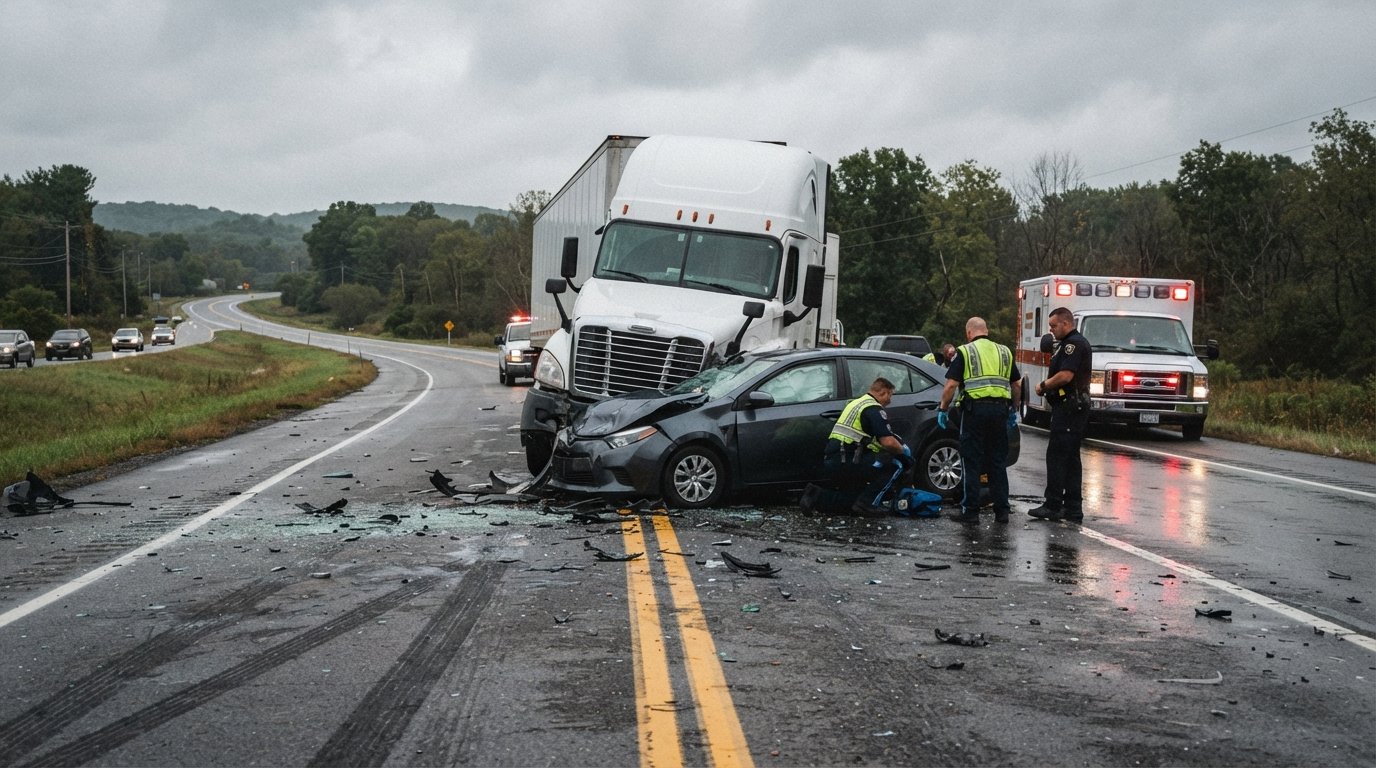
Commercial Vehicle Accident Claim When the Truck Crossed the Center Line
Injured when a truck crossed the center line? Get a free case review and protect your claim. Call (855)-545-2917 to speak with a participating attorney.

By Wesley Turner
A head-on crash with a commercial truck is one of the most violent collisions on the road. When a truck crosses the center line, the physics are brutal: a loaded tractor-trailer can weigh 80,000 pounds, and the force of impact at highway speed often produces catastrophic injuries. In the chaotic aftermath, you may be dealing with emergency medical treatment, vehicle damage, and an insurance adjuster who calls before you have even left the hospital. Understanding how fault is established in a lane-departure crash, and why evidence disappears quickly, is critical to protecting your commercial vehicle accident claim when the truck crossed the center line.
Why Center-Line Crashes Demand a Different Claims Approach
A truck that crosses the center line has violated one of the most fundamental rules of the road. In most jurisdictions, this creates a strong presumption of negligence, but the insurance company for the trucking company will not simply write a check because the police report places their driver over the line. They will dispatch investigators, sometimes within hours, to build a defense that shifts blame or minimizes liability. This is not a standard car accident claim where two drivers exchange insurance cards and wait for estimates. A commercial vehicle accident claim when the truck crossed the center line involves complex liability theories, federal trucking regulations, and multiple corporate parties who have a financial interest in disputing fault.
The severity of injuries in these crashes also changes the stakes. Head-on and sideswipe collisions involving large trucks frequently result in traumatic brain injuries, spinal cord damage, internal organ trauma, and wrongful death. When medical bills climb into the hundreds of thousands of dollars and future care is uncertain, the insurance company's initial offer is rarely adequate. Early legal involvement can mean the difference between a claim that accounts for long-term needs and one that leaves you paying for care decades after the crash.
Reconstruction Evidence That Proves Lane Departure and Timing
Proving that a truck crossed the center line is usually straightforward at the scene: skid marks, debris fields, and witness statements all point to the point of impact. But timing is everything. The defense may argue that your vehicle drifted first, that the truck was forced to swerve, or that a sudden emergency left the driver no choice. Accident reconstruction experts use physical evidence to build a timeline that shows exactly when and how the truck left its lane.
Key reconstruction evidence includes:
- Yaw marks and tire striations that indicate steering input and vehicle rotation before impact
- Crush damage patterns that reveal speed, angle, and the point of maximum engagement
- Roadway evidence such as gouges, fluid trails, and debris scatter that establish post-impact movement
- Site measurements and photogrammetry to map lane boundaries, sight lines, and obstructions
An experienced reconstruction expert can also calculate speed from skid marks and crush depth, which matters because excessive speed reduces reaction time and increases the severity of a lane departure. If the truck was speeding in a construction zone or on a curve with limited visibility, that fact strengthens the claim that the driver was not exercising reasonable care. In our guide on gathering evidence after a commercial vehicle crash, we explain how scene documentation, witness canvassing, and early expert retention work together to preserve these details before they fade.
Driver Distraction, Fatigue, and Mechanical Failure as Causes
Why did the truck cross the center line? The answer often lies in the driver's behavior or the condition of the vehicle. Distraction is a leading factor: texting, adjusting a GPS, eating, or reaching for an object can take a driver's eyes off the road for several seconds, which at highway speed covers the length of a football field. Fatigue is equally dangerous. Federal hours-of-service rules limit how long a commercial driver may operate without rest, but violations are common, and a drowsy driver may drift across the center line without ever braking.
Mechanical failure is another possibility, and it requires immediate investigation. A blown tire, brake failure, or steering defect can cause a truck to veer into oncoming traffic. The trucking company may try to blame a parts manufacturer, but that does not erase their responsibility to maintain the vehicle and inspect it before each trip. An attorney can request maintenance records, driver logs, and inspection reports to determine whether the company knew or should have known about a defect. If the driver was distracted or fatigued, those facts may be documented in the driver's own records or revealed through depositions and cell phone forensics.
Black Box and Dashcam Data: The Digital Witness
Modern commercial trucks are rolling data recorders. Electronic logging devices track hours of service, speed, and location. Engine control modules capture throttle position, braking, and vehicle speed in the seconds before a crash. Many fleets also install dash cameras and collision-avoidance systems that record video and radar data. This digital evidence can show whether the truck was already drifting before the driver reacted, whether brakes were applied, and whether the driver was alert and compliant with rest rules.
The challenge is that this data is controlled by the trucking company, and it can be overwritten or deleted according to retention policies. Spoliation letters, which formally demand preservation of evidence, are a critical early step in any commercial vehicle accident claim when the truck crossed the center line. Without a timely demand, crucial black box data may be gone within days or weeks. An attorney who handles trucking litigation knows how to send preservation letters to the carrier, the insurer, and any third-party telematics providers, and can seek a court order if the company fails to comply.
Catastrophic Injury Claims Require Early Evidence Preservation
Catastrophic injuries change the calculus of a claim. When a crash results in permanent disability, disfigurement, or a lifetime of medical care, the evidence must support not only fault but also the full extent of damages. That means documenting the injury trajectory from the emergency room forward, including surgical records, rehabilitation notes, vocational assessments, and life-care plans. It also means preserving evidence that may establish liability beyond the driver, such as the company's hiring practices, training programs, and cargo-loading procedures.
Early preservation is especially important because memories fade, witnesses move, and physical evidence is cleared from the scene. A prompt investigation can secure surveillance video from nearby businesses, interview first responders, and photograph the vehicles before they are repaired or sold. If the trucking company tries to argue that you contributed to the crash, having a thorough reconstruction and a clear medical record helps counter that defense. The goal is to build a claim that is ready for trial from the start, which puts pressure on the insurer to negotiate fairly rather than exploit uncertainty.
How a Nationwide Attorney Network Matches Complex Crash Cases
Not every personal injury attorney handles commercial trucking cases. These claims involve federal regulations, corporate defendants, and expert witnesses who specialize in reconstruction and trucking safety. A nationwide attorney network can match you with a lawyer who has experience in your state's courts and the resources to investigate a multi-party crash. AutoInjuryAccident.com is a consumer matching site that connects injured people with participating attorneys across the country. The site is not a law firm or a lawyer referral service and does not provide legal advice, but it offers a free, confidential case review so you can speak with an attorney about your options without obligation.
If you are considering a commercial vehicle accident claim when the truck crossed the center line, ask yourself whether your current attorney has the bandwidth to depose corporate witnesses, retain a reconstruction expert, and litigate against a trucking company's legal team. If not, a network that focuses on serious injury cases may help you find a better fit. Submitting a form does not create an attorney-client relationship and does not require you to hire anyone. It is simply a way to get information and make an informed decision about your next steps.
For broader legal resources and information about attorney-related disputes, you can also visit AttorneyLawsuit, which covers topics like fee disputes and client rights. When your case involves a truck that crossed the center line, though, the priority is preserving evidence and understanding your state's fault rules before time runs out. A prompt, no-cost case review can help you see the path forward.