
DUI Arrest at a Sobriety Checkpoint: Know Your Rights
Arrested at a sobriety checkpoint? Know your rights and options. Call (855)-545-2917 for a free, confidential case review.

By Marcus Hale
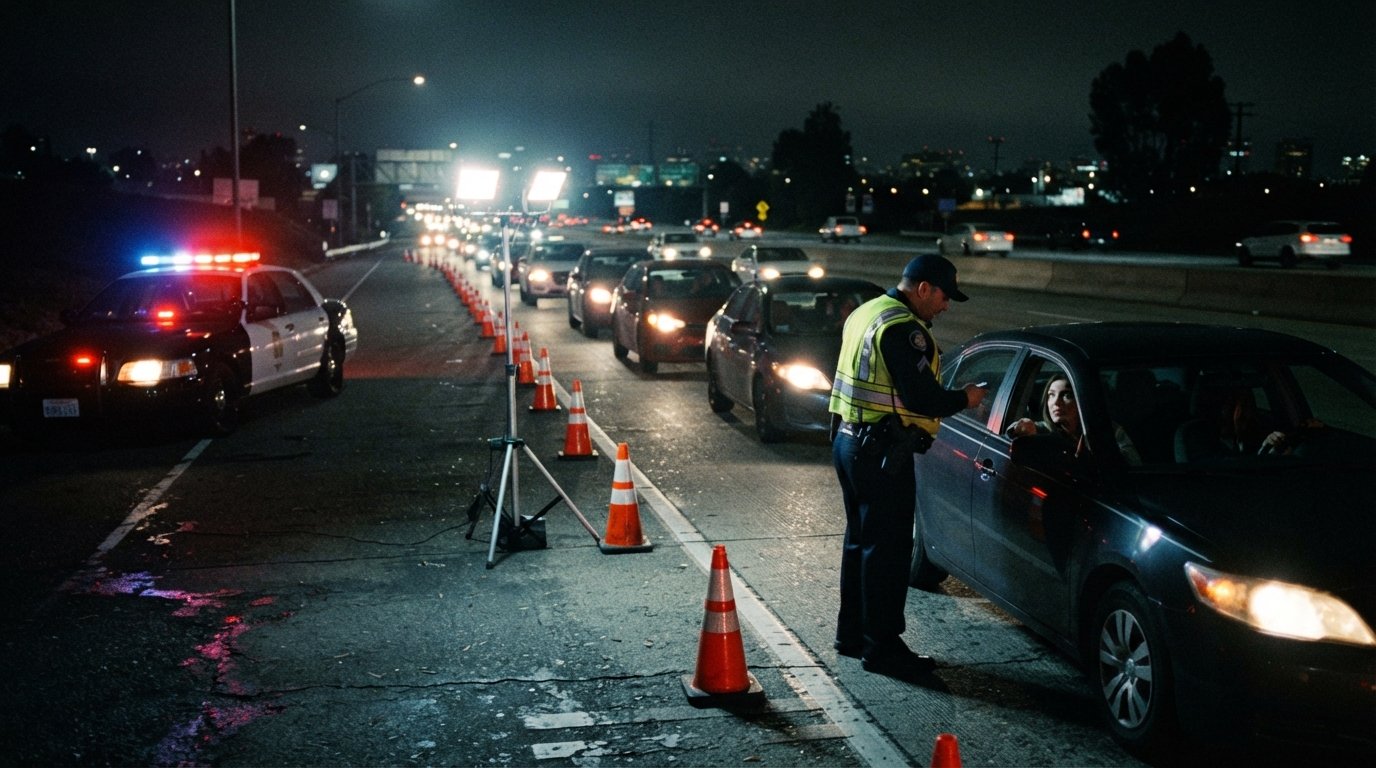
You see the flashing lights and the row of cones ahead. A sobriety checkpoint. Your heart races as an officer approaches your window. What are your rights at a DUI checkpoint, and what can you legally decline? Understanding the rules can help you stay calm and protect yourself during this stressful encounter. This guide explains how checkpoint stops differ from ordinary traffic stops, what you must provide, what you may refuse, and why the consequences of refusal matter. It also covers how checkpoint procedures can be challenged and why an attorney should review the stop's legality after an arrest.
How Checkpoint Stops Differ from Ordinary Traffic Stops
Sobriety checkpoints are legal in most states, but they operate under different rules than a typical traffic stop. In a normal stop, an officer needs reasonable suspicion that you committed a traffic violation or a crime before pulling you over. At a checkpoint, officers stop drivers based on a neutral formula, such as every third car, without any individualized suspicion. The U.S. Supreme Court upheld this practice in Michigan Department of State Police v. Sitz (1990), reasoning that the brief intrusion is outweighed by the public interest in reducing drunk driving.
However, the checkpoint itself must be conducted lawfully. Many states require advance public notice, supervision by a ranking officer, and a neutral stopping pattern. Some states do not allow checkpoints at all. Because rules vary widely, a stop that is legal in one state may be invalid in another. If you are arrested at a checkpoint, the legality of the stop becomes a key issue for your defense attorney to examine.
At a checkpoint, the officer's initial contact is usually brief. They may ask for your license and registration, check for signs of impairment, and ask a few questions. You are not required to answer questions beyond identifying yourself, but refusing to interact at all can raise suspicion. The key difference is that the officer does not need probable cause to stop you, but they do need probable cause to arrest you for DUI.
What You Must Provide and What You May Decline
When an officer stops you at a checkpoint, you are legally required to provide certain basic information. In most states, you must show your driver's license, vehicle registration, and proof of insurance if asked. You must also identify yourself. Failing to provide these can lead to separate charges or citations.
Beyond those basics, you have rights. You may decline to answer questions about where you are going, where you have been, or whether you have been drinking. You may also decline to perform field sobriety tests, such as the walk-and-turn or one-leg stand. These tests are voluntary in most states, and refusing them cannot be used against you at trial in some jurisdictions, though the officer may still arrest you based on other observations.
You may also decline a preliminary breath test (PBT) at the roadside, which is typically used to establish probable cause for arrest. However, refusing the formal chemical test after arrest (breath or blood) triggers implied consent laws. These laws require you to submit to testing, and refusal can result in automatic license suspension and other penalties. The consequences of refusing tests are serious and vary by state, so you should weigh them carefully.
Remaining silent is another option, but it has limits. You have the right to remain silent to avoid self-incrimination, but you must still provide identification and comply with lawful orders. Being polite and calm is important, as officers may interpret silence or refusal as evidence of impairment. An attorney can help you understand the specific rules in your state.
Why Remaining Silent and Declining Tests Has Consequences to Weigh
Choosing to remain silent or decline tests is a strategic decision, not a simple one. On one hand, declining field sobriety tests and preliminary breath tests can limit the evidence the prosecution has against you. Field sobriety tests are subjective, and officers may misinterpret your performance. By declining, you prevent the officer from using a shaky test result as probable cause.
On the other hand, refusing the formal chemical test after arrest can have immediate and severe consequences. Under implied consent laws, your driver's license may be suspended for a period, often longer than if you had submitted to testing and failed. In some states, refusal can be used as evidence of guilt at trial. Prosecutors may argue that you refused because you knew you were intoxicated.
Remaining silent can also backfire. While you have the right not to answer questions, officers may view your silence as evasive. They may then look for other signs of impairment, such as bloodshot eyes or the smell of alcohol, to build their case. In some states, you must at least provide your name and identification, and refusing to do so can lead to additional charges.
The best approach depends on your specific situation and state law. An experienced DUI attorney can advise you on how to handle a checkpoint stop and whether to submit to tests. If you are arrested, the attorney will review the stop's legality and the evidence against you.
How Checkpoint Procedures Can Be Challenged in Some Cases
Even though checkpoints are legal in many states, they must follow strict procedures. If the police fail to comply with these rules, the stop and any resulting arrest may be challenged. Common grounds for challenging a checkpoint include:
- Lack of proper authorization: The checkpoint must be approved by a supervisor and conducted according to a written policy.
- No neutral stopping pattern: Officers must stop vehicles based on a predetermined formula, not on whim or discriminatory criteria.
- Inadequate public notice: Many states require advance publicity so drivers are aware of the checkpoint.
- Improper location or timing: Checkpoints must be set up in a safe location and for a legitimate purpose.
- Racial profiling: If the checkpoint is used to target certain groups, it violates equal protection rights.
If any of these rules are violated, a judge may suppress the evidence obtained during the stop, which could lead to dismissal of the DUI charge. However, challenging a checkpoint requires a skilled attorney who understands the case law and procedural requirements in your state.
In addition to procedural challenges, the officer's conduct during the stop can be scrutinized. For example, if the officer prolonged the stop beyond what was necessary, or if the officer lacked probable cause to arrest, the arrest may be invalid. An attorney will review the police report, any video footage, and witness statements to identify weaknesses in the prosecution's case.
It is important to remember that not all states allow checkpoints. In states where they are illegal, any arrest resulting from a checkpoint stop may be challenged on that basis alone. Because the law varies, you need legal advice tailored to your jurisdiction.
Why an Attorney Reviews the Stop's Legality After an Arrest
After a DUI arrest at a sobriety checkpoint, the first thing an attorney will do is review the legality of the stop. This involves examining whether the checkpoint was authorized, whether the officers followed proper procedures, and whether there was probable cause to arrest you. If the stop was illegal, any evidence obtained from it may be suppressed, which can lead to a dismissal of the charges.
The attorney will also look at the entire encounter, from the moment you were stopped to the moment you were arrested. They will check for violations of your constitutional rights, such as unreasonable search and seizure or failure to read your Miranda rights. They will also review the results of any field sobriety tests or chemical tests, and may challenge their accuracy.
Because DUI laws are complex and vary by state, having an attorney who knows the local rules is crucial. If you are facing a DUI charge, you can request a free, confidential case review from participating attorneys through AutoInjuryAccident.com's attorney connection service. The site is not a law firm or lawyer referral service, and it does not provide legal advice, but it can connect you with attorneys who may be able to help. Submitting a form does not create an attorney-client relationship or obligate you to hire a lawyer.
For more information on the legal process after a DUI arrest, including what to expect at your first court appearance, see our guide on court date and arraignment after a DUI arrest. This resource explains the steps involved and how to prepare.
Additionally, if you are researching legal rights and attorney misconduct, you may find useful resources at AttorneyLawsuit.com, a legal information website focused on attorney-related lawsuits and consumer guidance.
Remember, the information in this article is educational and not legal advice. Every case is different, and you should consult with a licensed attorney in your state for advice specific to your situation.
Practical Steps to Take at a Checkpoint
If you approach a sobriety checkpoint, here are some practical steps to protect your rights:
- Stay calm and be polite. Cooperate with the officer's requests for your license and registration.
- Provide only the required information. You must identify yourself and provide documents, but you do not have to answer questions about drinking or your destination.
- Decline field sobriety tests and preliminary breath tests if you choose. Politely say, "I respectfully decline."
- If arrested, do not resist. Submit to the formal chemical test if required by implied consent laws, or accept the consequences of refusal. Ask to speak with an attorney.
- Document everything you remember. Write down details about the stop, the officers' conduct, and any statements made.
These steps can help you avoid escalating the situation and preserve your rights. However, the decision to refuse tests or remain silent should be made with an understanding of your state's laws.
Understanding Your Rights at a Sobriety Checkpoint
In summary, at a sobriety checkpoint, you must provide identification and vehicle documents, but you may decline to answer questions and refuse field sobriety tests. The consequences of refusing chemical tests after arrest are significant and vary by state. Checkpoint procedures can be challenged if they violate legal requirements, and an attorney can review the stop's legality to build a defense. If you are arrested, seek legal help promptly. A free case review can help you understand your options and connect with a qualified DUI attorney in your area. Remember, this article is for informational purposes only and does not constitute legal advice.