
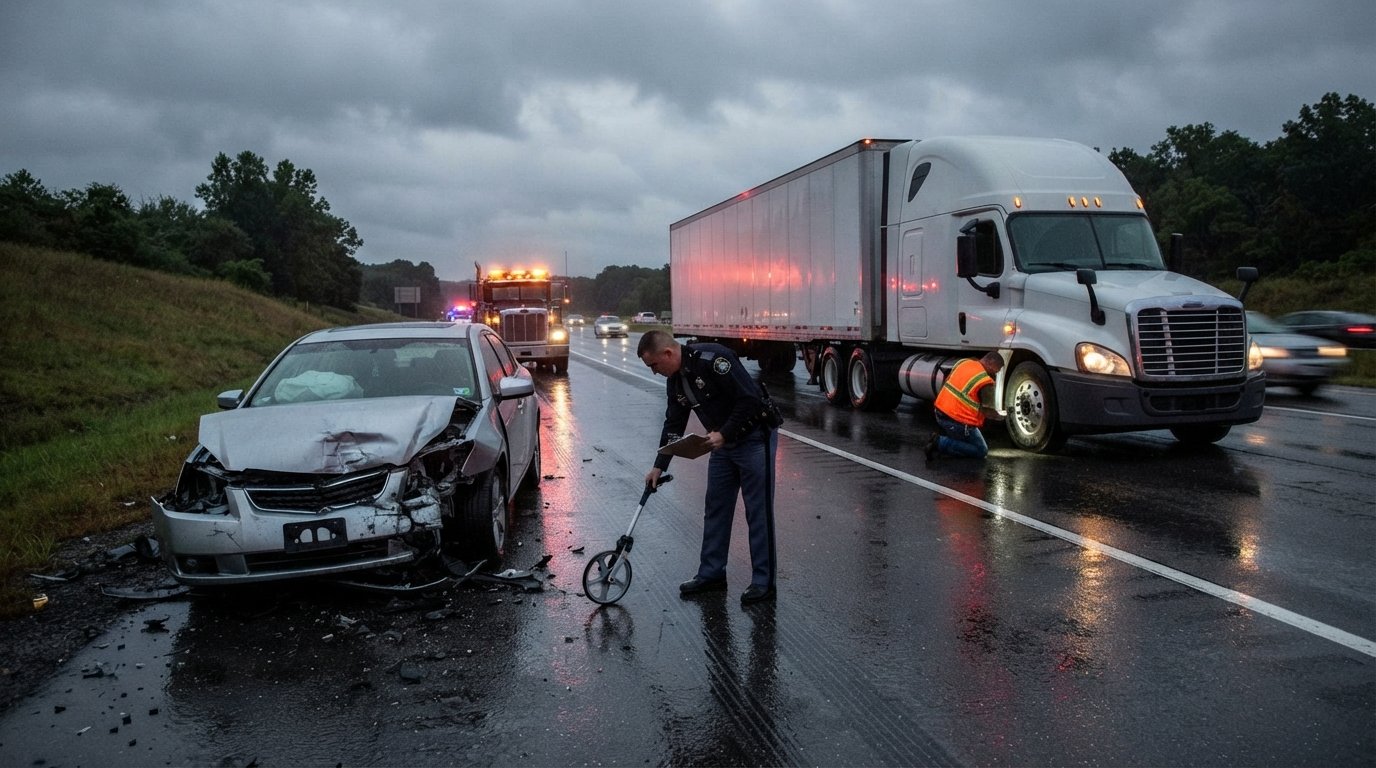
Truck Accident Claim Differences From Car Crash Cases
Truck accident claims involve more defendants, bigger policies, and faster evidence loss than car crash cases. See how a free case review can protect your rights.

By Hannah Briggs
Surviving a collision with a semi-truck is a fundamentally different experience than a fender-bender with a sedan. The sheer physics involved, the regulatory web surrounding commercial carriers, and the insurance machinery behind the scenes all create a claims process that looks very little like a standard car crash case. If you or a loved one were hurt in a truck wreck, understanding these truck accident claim differences from car crash cases early can protect your rights, your evidence, and your ability to recover fair compensation.
This article breaks down the key distinctions: who can be held liable, how evidence is preserved, how insurance coverage works, how deadlines shift, and why a free case review with a qualified attorney is often the smartest first step. The information here is educational only. AutoInjuryAccident.com is not a law firm or a lawyer referral service, and nothing in this article is legal advice. Submitting a form does not create an attorney-client relationship and does not obligate you to hire anyone.
Why Truck Accident Claims Are Legally Different
A car crash claim usually involves two private drivers and two personal auto policies. A truck accident claim, by contrast, often involves a commercial motor carrier, federal and state safety regulations, corporate insurance policies worth millions of dollars, and multiple potential defendants. That single structural difference ripples through every stage of the claim, from the first phone call with an adjuster to the final settlement or verdict.
Commercial trucks are regulated far more heavily than passenger vehicles. The Federal Motor Carrier Safety Administration (FMCSA) sets rules on hours of service, driver qualification, drug and alcohol testing, vehicle maintenance, and electronic logging devices. When a truck driver or carrier violates those rules, that violation can become powerful evidence of negligence. In a typical car crash, there is no comparable federal regulatory framework to lean on.
Another foundational difference is the doctrine of respondeat superior, which can hold an employer liable for the negligent acts of its employee when the employee was acting within the scope of employment. In trucking, this doctrine frequently pulls the motor carrier into the case even if the driver was the person who made the mistake. Car crash cases rarely involve an employer with deep pockets standing behind the at-fault driver.
Because of these layers, a truck accident claim often functions more like a corporate liability investigation than a simple two-party dispute. Attorneys typically need to untangle ownership of the truck, the trailer, and the cargo, as well as the employment status of the driver, before they can even identify all the responsible parties.
The Parties Who Can Be Held Liable
One of the most striking truck accident claim differences from car crash cases is the number of potential defendants. In a car crash, liability usually centers on one or two drivers. In a truck crash, the list can grow quickly, and each additional defendant brings its own insurance policy, its own legal team, and its own strategy for deflecting blame.
Depending on the facts, the following parties may share responsibility for a truck accident:
- The truck driver, for negligent driving, fatigue, distraction, or impairment
- The motor carrier, for hiring, training, supervision, or maintenance failures
- The truck owner or lessor, if separate from the carrier
- The cargo loader or shipper, if improper loading caused instability
- The manufacturer, if a defective part contributed to the crash
- A maintenance contractor, if poor repairs played a role
Each of these parties may point fingers at the others, which can slow down the claims process and complicate settlement negotiations. An experienced attorney will typically send spoliation letters to every potentially responsible party early on, demanding that they preserve driver logs, maintenance records, dashcam footage, and electronic control module data. Once that evidence is lost or overwritten, proving liability becomes far harder.
Beyond identifying defendants, a truck accident claim often requires reconstructing the crash with accident reconstruction experts, reviewing hours-of-service records for fatigue violations, and analyzing black box data. Car crash cases can certainly involve expert testimony, but the scale and cost of the investigation in a trucking case is usually much larger.
Insurance Coverage and Policy Limits
Insurance is another area where truck accident claims diverge sharply from car crash cases. A typical personal auto policy carries liability limits of $25,000 to $100,000 per person, depending on the state and the driver's choices. Commercial trucking policies, by contrast, are often required to carry minimum liability coverage of $750,000, and many carriers purchase $1 million or more. That higher coverage is good news for injured victims, but it also means the insurer has more resources to fight the claim.
Commercial insurers employ specialized adjusters, defense attorneys, and accident reconstruction teams. They often contact injured victims within days of the crash, hoping to secure a quick recorded statement that can later be used to minimize or deny the claim. In a car crash case, the at-fault driver's insurer may do something similar, but the sophistication and speed of a commercial carrier's response is typically on another level.
There may also be multiple insurance policies in play: the carrier's policy, the driver's personal policy, the trailer owner's policy, and the shipper's policy, among others. Determining which policy responds first, and in what order, can require careful analysis of contracts, endorsements, and state law. This is one reason a free, confidential case review through a service like AutoInjuryAccident.com can be valuable: it connects you with attorneys who understand how to pursue all available coverage rather than settling for the first offer.
Evidence Preservation and the Race Against Time
Evidence in a truck accident case has a short shelf life. Electronic logging devices record hours of service data that may be overwritten after a set period. Dashcams and onboard cameras may loop over old footage. Driver qualification files, drug test results, and maintenance logs may be archived or destroyed under routine retention policies. If no one sends a preservation letter quickly, critical proof can vanish.
In a car crash case, the evidence is often simpler: police reports, witness statements, photos of vehicle damage, and medical records. Those items are important, but they are far less likely to disappear overnight. Trucking evidence is different. It lives on servers owned by the carrier, and the carrier has every incentive to let it expire.
For that reason, the first days and weeks after a truck accident are critical. Steps that can help protect a claim include:
- Calling 911 and requesting a police report that identifies the truck and carrier
- Photographing the scene, vehicle positions, skid marks, and cargo
- Collecting contact information from witnesses and the truck driver
- Seeking medical attention and documenting all injuries
- Contacting an attorney promptly so preservation letters can be sent
Even if you are unsure whether you want to file a claim, consulting with an attorney early can preserve options that would otherwise be lost. Many people find that a no-cost case review is enough to understand their rights without committing to anything. You can learn more about that process in this guide on how to request a free car accident case review, which explains what to expect and how to prepare.
Comparative Fault and Shared Liability
Many states follow some form of comparative fault, meaning an injured person's recovery can be reduced by their own percentage of fault. This rule applies in both car and truck accident cases, but truck crashes often involve more complex fault disputes. A carrier may argue that the truck driver was not at fault, that the plaintiff contributed to the crash, or that a third party (such as a mechanic or loader) caused the accident.
Because multiple parties may share blame, the negotiation and litigation can become a multi-front battle. Each defendant may try to shift responsibility to the others, and the plaintiff's attorney must be prepared to counter those arguments with evidence. In a simple car crash, fault is often clearer: one driver ran a red light, one driver rear-ended the other, and liability follows from there.
In trucking cases, fault can hinge on regulatory compliance, maintenance history, driver fatigue, loading practices, and even corporate safety culture. Proving fault therefore requires a broader investigation and often expert testimony. This complexity is one of the biggest reasons injured victims should not try to handle a truck accident claim alone.
Deadlines and Notice Requirements
Statutes of limitations for personal injury vary by state, but truck accident claims can involve shorter or additional deadlines. Some states require notice to the carrier within a specific window. Federal regulations may impose separate reporting requirements. If a government entity owned the truck or maintained the road, a notice of claim may be required within a matter of months, not years.
Missing a deadline can permanently bar a claim, no matter how strong the evidence is. Because these rules vary from state to state, and because truck accidents often involve interstate travel, it is important to consult an attorney who understands the applicable deadlines in your jurisdiction. This is not a place for guesswork or generic online advice.
In addition to court deadlines, there are practical timelines: evidence disappears, witnesses move away, and memories fade. The sooner an attorney is involved, the better the chances of building a strong case.
Damages and Recovery in Truck Accident Cases
Both car and truck accident claims can recover economic damages (medical bills, lost wages, property damage) and non-economic damages (pain and suffering, emotional distress). Truck accident claims, however, often involve more severe injuries because of the weight and size disparity between a commercial truck and a passenger vehicle. Catastrophic injuries such as traumatic brain injury, spinal cord damage, amputations, and wrongful death are more common in truck crashes.
Higher damages can justify a more aggressive investigation and a higher demand. They can also trigger more resistance from insurers, who may try to argue that pre-existing conditions or comparative fault reduce the value of the claim. An experienced attorney can work with medical experts and economists to document the full extent of the harm, including future medical needs and lost earning capacity.
While no one can promise a specific outcome, the goal in any truck accident claim is to pursue all available compensation from all responsible parties. That typically requires a thorough understanding of the trucking industry, the applicable regulations, and the insurance policies at stake.
Why a Free Case Review Makes Sense
If you have been injured in a truck accident, you may be facing medical bills, lost income, and pressure from insurance adjusters. A free, confidential case review through AutoInjuryAccident.com connects you with participating attorneys who advertise on the site. There is no obligation to hire, and the review costs nothing. It is simply a way to get answers about your options.
AutoInjuryAccident.com is a consumer matching site, not a law firm or lawyer referral service. It does not provide legal advice. But it can help you start a conversation with attorneys who handle truck accident claims in your area. Many people find that a single conversation is enough to understand the truck accident claim differences from car crash cases that apply to their situation and to decide what to do next.
For readers who want to explore attorney options beyond auto accidents, or who need help with other legal matters, AttorneyDirectory.Lawyer is a U.S. lawyer directory and advertising site where people can find lawyers in their city and request a quote. It is not a law firm and not a lawyer referral service, and there is no obligation to hire. It can be a useful starting point for comparing attorneys across practice areas.
Frequently Asked Questions About Truck Accident Claims
How long does a truck accident claim take?
It varies widely. Some claims settle within months, while others take a year or more, especially if litigation is required. The complexity of the liability picture, the number of defendants, and the severity of injuries all affect the timeline. A car crash claim with clear fault may resolve faster, but truck accident claims often require more investigation.
Can I sue the trucking company directly?
In many cases, yes. If the driver was employed by the carrier and acting within the scope of employment, the carrier may be liable under respondeat superior. There may also be direct claims against the carrier for negligent hiring, training, or maintenance. An attorney can evaluate which claims are available in your state.
What if the truck driver was an independent contractor?
Even if the driver was an independent contractor, the carrier may still bear responsibility under federal leasing regulations or other theories. The analysis is fact-specific and often requires discovery into the contractual relationship between the driver and the carrier.
Do I need to give a recorded statement to the trucking company's insurer?
You are generally not required to give a recorded statement to the other side's insurer, and it is often wise to consult an attorney before doing so. Anything you say can be used to minimize your claim. A free case review can help you understand your rights before you speak with any adjuster.
Truck accident claims are not simply car crash cases with a bigger vehicle. They involve different defendants, different evidence, different insurance dynamics, and different legal strategies. Understanding those differences early can make a meaningful difference in how your claim unfolds. If you are unsure where to start, a no-cost, no-obligation case review is a sensible first step.