
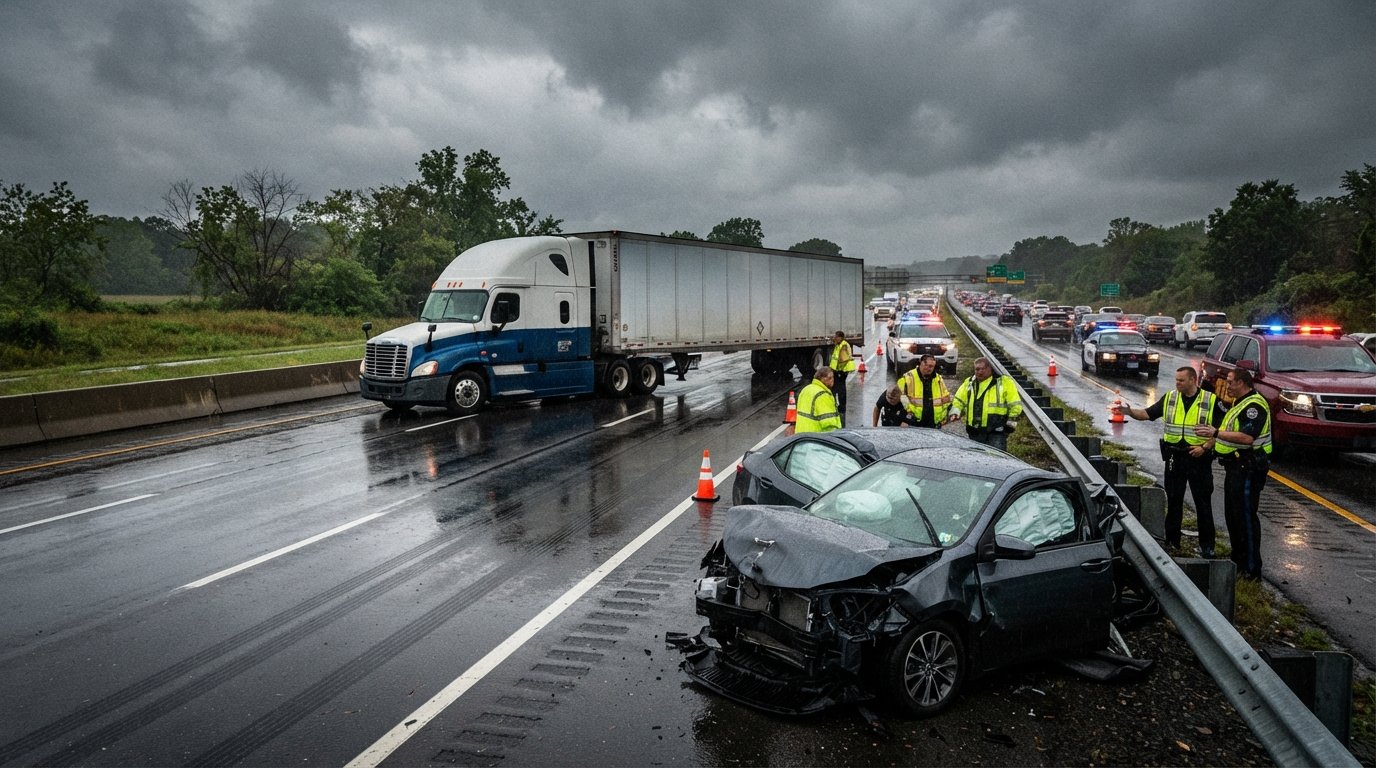
Truck Jackknife Accident: Who Is Liable for the Crash?
Truck jackknife accident who is liable for the crash? Find out how to prove fault and preserve evidence. Call (855)-545-2917 for a free case review.

By Elena Vasquez
A truck jackknife accident is one of the most terrifying sights on a highway: a massive tractor-trailer folding at the cab, sliding sideways, and blocking every lane in an instant. If you survived one of these crashes, you are likely dealing with serious injuries, a mangled vehicle, and an insurance company that is already trying to pin the blame on the truck driver or on you. But determining who is liable for a truck jackknife accident is rarely that simple. Liability can rest with the driver, the motor carrier, a maintenance contractor, a cargo loader, or even a parts manufacturer. This article explains the common causes of jackknife crashes, the federal rules that apply, and the evidence you need to preserve if you want to hold the right party accountable.
What Causes a Truck Jackknife Accident?
A jackknife happens when a tractor-trailer's drive wheels lock up or lose traction, causing the trailer to swing out of line with the cab. The result looks like a folding pocketknife, and the trailer can sweep across multiple lanes in seconds. While every crash is unique, most jackknife accidents trace back to one or more of the following factors.
- Hard braking: Slam on the brakes in a rig without an anti-lock braking system (ABS), or with poorly maintained brakes, and the wheels can lock, sending the trailer sideways.
- Bad weather: Rain, snow, ice, and even strong crosswinds reduce traction and make a jackknife far more likely, especially if the driver is speeding for conditions.
- Load imbalance: Cargo that is loaded too far back, too light on the drive axles, or improperly secured can shift weight and destabilize the trailer.
- Driver error: Overcorrecting, following too closely, or failing to adjust speed on a curve or decline are common triggers.
- Mechanical failure: Defective brakes, worn tires, or a malfunctioning ABS system can turn a routine stop into a catastrophe.
These causes matter because they point to different responsible parties. A hard-braking crash caused by a tailgating driver may be the driver's fault. But if the brakes failed because the carrier skipped maintenance, the trucking company shares blame. If the load shifted because a warehouse worker loaded it improperly, the loading company may be on the hook. Identifying the cause is the first step in answering the question of who is liable for a truck jackknife accident.
Federal Rules on Brakes and Maintenance
The Federal Motor Carrier Safety Administration (FMCSA) sets minimum standards for commercial trucks, and those rules often become the backbone of a liability case. For example, 49 CFR 393.40 requires trucks to have brakes that can stop the vehicle within a certain distance, and 49 CFR 396.3 requires carriers to systematically inspect, repair, and maintain all vehicles under their control. A carrier that ignores brake maintenance is not just negligent; it may be in violation of federal safety regulations, which can be powerful evidence in a civil lawsuit.
Anti-lock braking systems have been mandatory on new heavy trucks since 1997, and they are designed specifically to prevent wheel lockup that leads to jackknifing. If a truck involved in a jackknife crash was built after that date and its ABS was disabled or broken, that is a red flag. Similarly, tires must have adequate tread depth and be properly inflated, and loads must be secured to prevent shifting. When a crash happens, investigators will look at maintenance records, driver inspection reports, and the truck's electronic logging device (ELD) to see whether the carrier and driver were following the rules.
Who Can Be Held Liable for a Truck Jackknife Accident?
One of the most common misconceptions is that the truck driver is always the only one at fault. In reality, a jackknife crash often involves multiple potentially liable parties. The driver may have been speeding or distracted, but the carrier may have pressured the driver to meet an unrealistic schedule or failed to maintain the truck. The loading company may have improperly distributed the weight. A parts manufacturer may have sold defective brake components. Even a third-party mechanic could be responsible for a shoddy repair.
Under a legal doctrine called respondeat superior, an employer can be held vicariously liable for the negligent acts of its employee if the employee was acting within the scope of employment. That means the trucking company can be sued for the driver's mistakes. But carriers often try to classify drivers as independent contractors to avoid this liability. Courts look beyond labels to the actual working relationship, and many states have tests that focus on control. If the carrier controls the driver's schedule, routes, and vehicle, a court may still hold the carrier responsible.
Beyond vicarious liability, carriers can be directly liable for their own negligence: negligent hiring, inadequate training, failure to supervise, or forcing drivers to violate hours-of-service rules. In some cases, a broker or shipper that selected the carrier may also share fault. Because liability is so fact-specific, it is wise to speak with an attorney who can investigate the full chain of responsibility. If you are exploring your options, you can learn how liability works in rideshare crashes to see how similar principles apply when multiple parties are involved.
Preserving Electronic Logs and Inspection Records
After a jackknife crash, evidence can disappear quickly. Trucking companies are required to retain certain records for specific periods, but they may not always preserve them voluntarily. The ELD records show the driver's speed, braking, and hours of service in the moments before the crash. Maintenance files reveal whether the brakes and tires were in good condition. Driver qualification files show whether the driver was properly licensed and trained. All of this can be crucial to proving liability.
An attorney can send a spoliation letter, which formally demands that the carrier preserve all relevant evidence, including the truck's electronic control module (ECM) data, dispatch records, and dashcam footage. Without such a letter, the carrier might overwrite or destroy data in the normal course of business. If you have been injured in a truck jackknife accident, do not wait to seek legal help. You can request a free, confidential case review through a platform like LawyerOffer to connect with attorneys who understand trucking litigation and can act quickly to preserve evidence.
Steps to Take After a Truck Jackknife Accident
If you are physically able, the actions you take in the minutes and days after a jackknife crash can significantly affect your claim. Here are the key steps to protect your health and your legal rights:
- Call 911 and get medical attention: Even if you feel fine, adrenaline can mask serious injuries. A police report and medical records are also valuable evidence.
- Document the scene: Take photos of the truck's position, the road conditions, your vehicle damage, and any visible injuries. Get contact information from witnesses.
- Exchange information: Obtain the truck driver's name, license plate, and the carrier's name and insurance details. Do not discuss fault with anyone.
- Report to your insurer: Notify your own insurance company, but avoid giving a recorded statement to the trucking company's insurer without legal advice.
- Consult an attorney: A lawyer can investigate the crash, identify all liable parties, and preserve critical evidence before it vanishes.
It is important to remember that fault rules, insurance requirements, and deadlines vary by state. What works in one jurisdiction may not work in another. An experienced attorney can explain how your state's laws apply to your situation and help you avoid mistakes that could jeopardize your recovery.
What Damages Can You Recover?
If another party is found liable for the jackknife crash, you may be entitled to compensation for your losses. Economic damages include medical bills, lost wages, and future medical care. Non-economic damages include pain and suffering, emotional distress, and loss of enjoyment of life. In cases involving gross negligence or willful misconduct, punitive damages may also be available, though they are not guaranteed. The specific damages recoverable depend on the facts of your case and the laws of your state.
Insurance companies for trucking carriers often employ teams of lawyers and accident reconstruction experts to minimize payouts. They may argue that you contributed to the crash or that the driver was not at fault. Having your own attorney levels the playing field and ensures that your rights are protected. Remember that AutoInjuryAccident.com is not a law firm or lawyer referral service, and submitting a form does not create an attorney-client relationship or obligate you to hire a lawyer. It is simply a free way to explore your options.
The Bottom Line on Liability
Determining who is liable for a truck jackknife accident requires a thorough investigation of the driver's actions, the carrier's maintenance and training practices, the loading process, and the condition of the truck. Federal regulations on brakes and maintenance provide a useful framework, but every case turns on its own facts. By preserving evidence like electronic logs and inspection records and seeking legal guidance early, you can improve your chances of holding the responsible parties accountable. If you or a loved one has been hurt in a jackknife crash, reach out to a qualified attorney for a no-cost case review and take the first step toward protecting your rights.