
Rideshare Driver Accident Claim When I Was Not on a Trip
Injured by an off-trip rideshare driver? Call (855)-545-2917 for a free case review to map coverage layers and protect your claim.

By Wendy Walsh
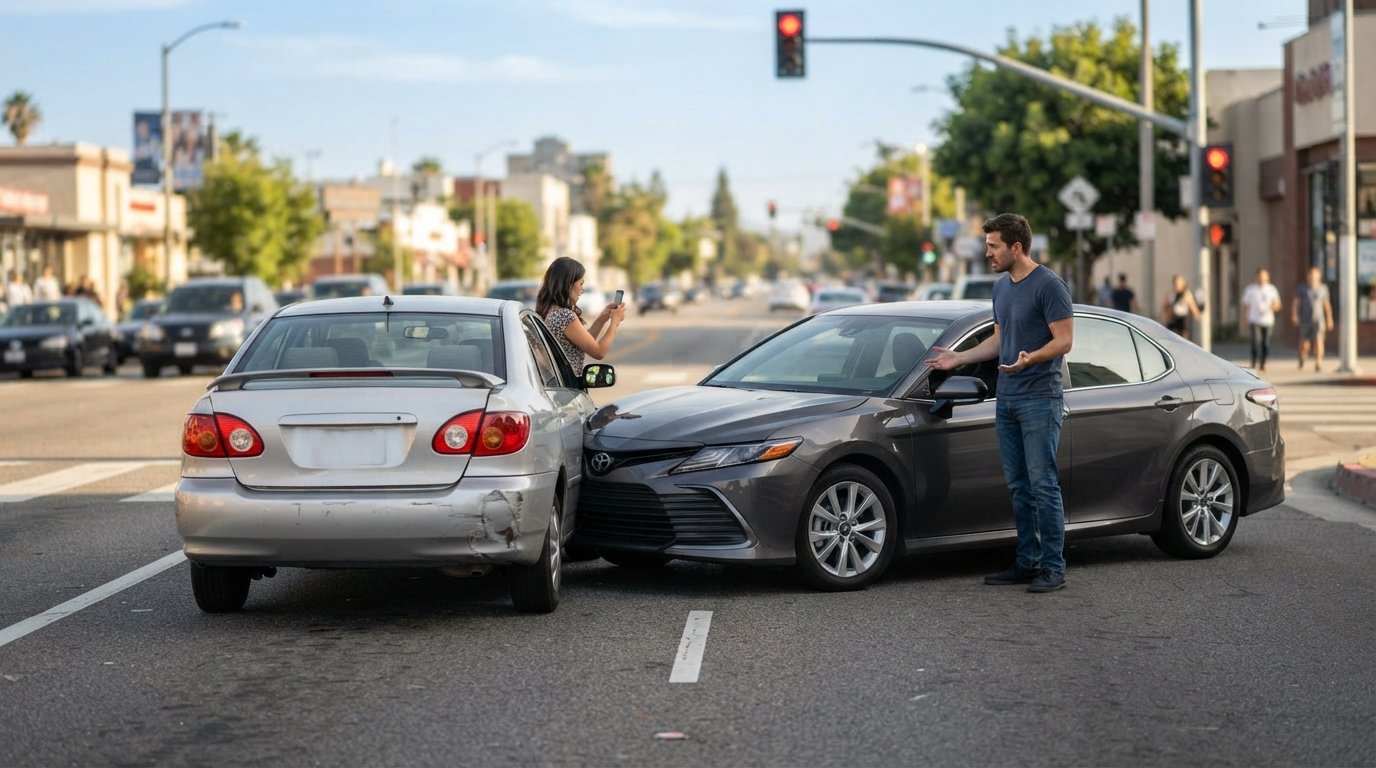
You are sitting at a red light when a car with a rideshare sticker slams into your rear bumper. The driver apologizes, explains he was not currently on a trip, and suggests you handle it privately. Your neck is already stiffening, your car is damaged, and you have no idea whether his personal car insurance will cover your injuries or whether the rideshare company will deny everything because the app was not actively dispatching a passenger. This scenario plays out every day, and the coverage answer is far more complicated than most people expect.
A rideshare driver accident claim when I was not on a trip sits in one of the most confusing gaps in modern auto insurance. The driver was working, sort of. The app may have been on, but no passenger was in the car. Uber or Lyft may deny involvement because no ride was in progress, while the driver's personal insurer may deny coverage because the vehicle was being used for commercial purposes. Injured victims are left holding medical bills, repair estimates, and lost wages while insurers point fingers at each other. Understanding how these coverage layers work, and how to establish the driver's actual app status, is the first step toward protecting your rights.
How Rideshare Coverage Phases Depend on App Status
Major rideshare companies like Uber and Lyft structure their insurance coverage in phases, and the phase that applies at the moment of a crash determines which policy responds. These phases are tied directly to what the driver was doing in the app at the time of the collision, not to what the driver says afterward.
In general, the phases look like this:
- App off, driver not working: The driver's personal auto policy is the primary coverage. Rideshare company insurance does not apply.
- App on, waiting for a request: Rideshare companies typically provide limited liability coverage, often around $50,000 per person and $100,000 per accident, plus contingent coverage that may apply if the personal policy denies the claim.
- App on, ride accepted, passenger not yet picked up: Coverage usually increases to $1 million in liability coverage.
- Passenger in the vehicle or ride in progress: The full $1 million liability policy generally applies.
The critical takeaway is that the difference between phase one and phase two is simply whether the app was on, and that difference can mean the difference between a personal policy with minimal limits and a rideshare policy with substantial coverage. When a driver says "I was not on a trip," that statement does not tell you whether the app was on and waiting, or completely off. Those are two very different scenarios with very different insurance consequences.
For injured victims, this means the first question is never "was the driver on a trip?" The first question is "what was the driver's app status at the moment of impact?" That single fact determines which insurance company you should be pursuing and how much coverage may be available.
Why the Driver's Personal Policy May or May Not Respond
Most personal auto insurance policies contain a rideshare exclusion or a livery exclusion. These clauses are designed to prevent policyholders from using a personal policy for commercial driving without paying commercial rates. When a driver is actively logged into a rideshare app, even if no passenger is in the car, the personal insurer may argue that the vehicle was being used for a business purpose and deny the claim entirely.
However, the outcome is not always that simple. Some personal policies will cover a driver who was logged into the app but not actively on a trip, particularly if the policy language limits the exclusion to periods when a passenger is present or a ride has been accepted. Other policies contain broader exclusions that apply any time the vehicle is available for hire. The specific wording of the driver's personal policy matters enormously, and that wording varies by insurer and by state.
There is also the question of contingent coverage. Rideshare companies often provide contingent liability coverage that kicks in when the driver's personal policy denies a claim during the app-on, waiting-for-request phase. This contingent coverage is not automatic, and the rideshare company may require proof that the personal insurer has denied coverage before it will respond. Injured victims who do not understand this back-and-forth can spend months chasing the wrong insurer while evidence disappears and deadlines pass.
If you were hurt by a driver who was between trips, you may be dealing with a personal insurer that wants to deny coverage, a rideshare company that wants to deny involvement, and a driver who may not have commercial coverage at all. Mapping these layers early is essential, and a free case review can help you identify which policies may actually respond to your injuries.
Gaps That Leave Injured Victims Chasing the Wrong Insurer
The most common mistake injured victims make after a rideshare crash is assuming that the rideshare company will automatically pay for their injuries. That assumption is often wrong, especially when the driver was not actively on a trip. The rideshare company's insurer may deny the claim outright if the app was off, and even if the app was on, the company may dispute the driver's status or the timing of the crash.
Another common gap involves uninsured and underinsured motorist coverage. If the rideshare driver's personal policy denies coverage and the rideshare company's contingent coverage does not apply, the driver may effectively be uninsured for your injuries. In that situation, your own uninsured motorist coverage may be the only available source of compensation. Many injured victims do not realize that their own policy can respond in a rideshare crash, and they never file the claim that could have protected them.
There is also the problem of commercial coverage requirements. Some states require rideshare drivers to carry additional coverage or to maintain commercial policies, while others rely entirely on the rideshare company's policy structure. These rules vary widely, and a victim who does not know the local rules can easily pursue the wrong insurer for months.
The practical result is a coverage maze. The driver's personal insurer may deny the claim, the rideshare company may deny the claim, and the victim may be left with medical bills and no clear path forward. This is exactly the situation where an experienced attorney can make a difference by identifying every available policy and demanding that each insurer respond according to its own contract language.
How to Establish the Driver's App Status at the Time of the Crash
Because coverage hinges on the driver's app status, proving that status becomes a central task in any rideshare accident claim. The driver's own statement is not enough, and it may not even be accurate. Fortunately, there are several sources of evidence that can establish what the driver was doing when the crash occurred.
Here are the key steps to take as soon as possible after a crash with a rideshare driver:
- Call the police and request a formal report. The responding officer should document the driver's statements, the presence of rideshare decals, and any visible app activity on the driver's phone. A police report creates an official record that can be used later to challenge inconsistent insurance denials.
- Photograph the scene, the vehicles, and the driver's phone if visible. If the driver's phone is mounted and showing an active app, that image can be powerful evidence. Photograph the rideshare decals, the license plate, and the driver's insurance card.
- Preserve your own records. Save your medical records, repair estimates, and any correspondence with insurers. Keep a log of every phone call and every statement made by the driver or the rideshare company.
- Request the driver's app data through legal process. Rideshare companies maintain detailed logs of when a driver logs on, accepts a request, and completes a trip. An attorney can send a preservation letter and, if necessary, subpoena those records to establish the driver's status at the exact moment of the crash.
Timing matters enormously in these cases. Rideshare companies may retain app data for only a limited period, and drivers may change their stories once they speak with an insurer. The sooner you act, the better your chances of securing the evidence that proves which coverage phase applies.
It is also important to remember that the driver has an incentive to minimize the extent of his or her working status. A driver who admits to being logged into the app may face higher insurance costs or even termination. That incentive makes independent evidence, such as app logs and police reports, far more valuable than the driver's own account.
Why a Case Review Can Map Coverage Layers in a Rideshare Crash
A rideshare crash involving an off-trip driver is not a simple insurance claim. It is a coverage puzzle that requires identifying every policy that might apply, understanding the contract language in each policy, and proving the driver's status at the moment of impact. Most injured victims do not have the time, resources, or legal knowledge to do this on their own, especially while recovering from injuries.
A free, confidential case review can help you map the coverage layers in your specific situation. An attorney can review the police report, the driver's insurance information, your own policy, and the rideshare company's coverage structure to determine which policies may respond. This review can also identify whether your own uninsured motorist coverage applies, whether the rideshare company's contingent coverage is available, and whether the driver's personal insurer has a valid basis for denial.
If you are dealing with a commercial vehicle crash involving a larger truck, the coverage analysis can be even more complex, and the differences between truck accident claims and car crash cases can affect which insurers and legal standards apply. In our guide on truck accident claim differences from car crash cases, we explain how commercial coverage and liability rules can change the strategy. The same principle applies to rideshare claims: the coverage structure drives the strategy.
When you request a case review through AutoInjuryAccident.com, you are connected with independent attorneys who advertise on the site. The site is not a law firm or a lawyer referral service, and it does not provide legal advice. Submitting a form does not create an attorney-client relationship and does not obligate you to hire anyone. The purpose is to give you a no-cost, no-obligation opportunity to understand your options and decide how to proceed.
For readers who want to understand how attorney-related disputes and legal resources work, AttorneyLawsuit provides information on legal malpractice, fee disputes, and consumer guidance involving lawyers and law firms. That kind of background can be useful when you are evaluating your own legal options, though it is not a substitute for personalized advice about your accident claim.
Steps to Take After a Crash With an Off-Trip Rideshare Driver
If you have been injured by a rideshare driver who was not on a trip, the actions you take in the first few days can shape the entire claim. Start by getting medical attention and documenting your injuries. Then focus on preserving evidence of the driver's status and notifying the correct insurers.
A practical sequence looks like this:
- Seek medical care immediately. Injuries from rear-end collisions and intersection crashes can take hours or days to become obvious, and early treatment creates a record that links your injuries to the crash.
- Report the crash to the police. A formal report is one of the strongest pieces of evidence you can have, especially if the driver's story changes later.
- Notify your own insurer. Even if you were not at fault, your policy may provide uninsured motorist coverage, medical payments coverage, or collision coverage that can help while the liability investigation continues.
- Do not give recorded statements to the rideshare company or the driver's insurer without legal guidance. These statements can be used to limit or deny your claim.
- Consult with an attorney about coverage layers. A case review can identify every policy that may apply and help you avoid chasing the wrong insurer.
Each of these steps serves a different purpose, but together they create a record that supports your claim and protects you from common insurer tactics. The most important thing is not to wait. Evidence fades, memories change, and app data may be deleted. The sooner you act, the stronger your position.
What to Expect When Multiple Insurers Are Involved
In a typical off-trip rideshare crash, you may find yourself dealing with two or three insurers at once: the driver's personal insurer, the rideshare company's insurer, and possibly your own insurer. Each has different contractual obligations, different coverage limits, and different reasons to deny or delay payment. Managing these communications without legal help can be overwhelming.
The driver's personal insurer will likely argue that the vehicle was being used for commercial purposes and that the policy excludes coverage. The rideshare company's insurer will likely argue that the driver was not on an active trip and that its coverage does not apply. Your own insurer may argue that its uninsured motorist coverage does not apply because the driver had some other coverage. These arguments are not always correct, but they can be effective against an unrepresented victim.
An attorney can cut through these arguments by demanding the specific policy language, requesting app data, and citing the legal standards that apply in your state. In many cases, the mere presence of legal representation changes how insurers respond, because they know the claim will be evaluated by someone who understands the coverage rules.
It is also important to understand that fault rules vary by state. Some states use pure comparative fault, some use modified comparative fault, and some use contributory negligence. These rules can affect your recovery even when the other driver is clearly at fault, and they interact with the coverage analysis in ways that are not obvious to most people.
If you are unsure which insurer should be paying your claim, a case review is a low-risk way to get clarity. You do not have to hire a lawyer to request a review, and you do not have to commit to anything. The goal is simply to understand your options before you make decisions that could affect your recovery.
Rideshare crashes involving off-trip drivers are among the most misunderstood accident claims in modern personal injury law. The driver was working, but not on a trip. The app may have been on, but no passenger was present. The personal policy may deny coverage, and the rideshare policy may deny involvement. Injured victims who understand these layers, preserve the right evidence, and seek guidance early are in a much better position to recover the compensation they deserve. If you were hurt in a crash with a rideshare driver who was not on a trip, do not assume the rideshare company will handle it. Take steps to protect your rights and get answers about the coverage that may apply to your situation.