
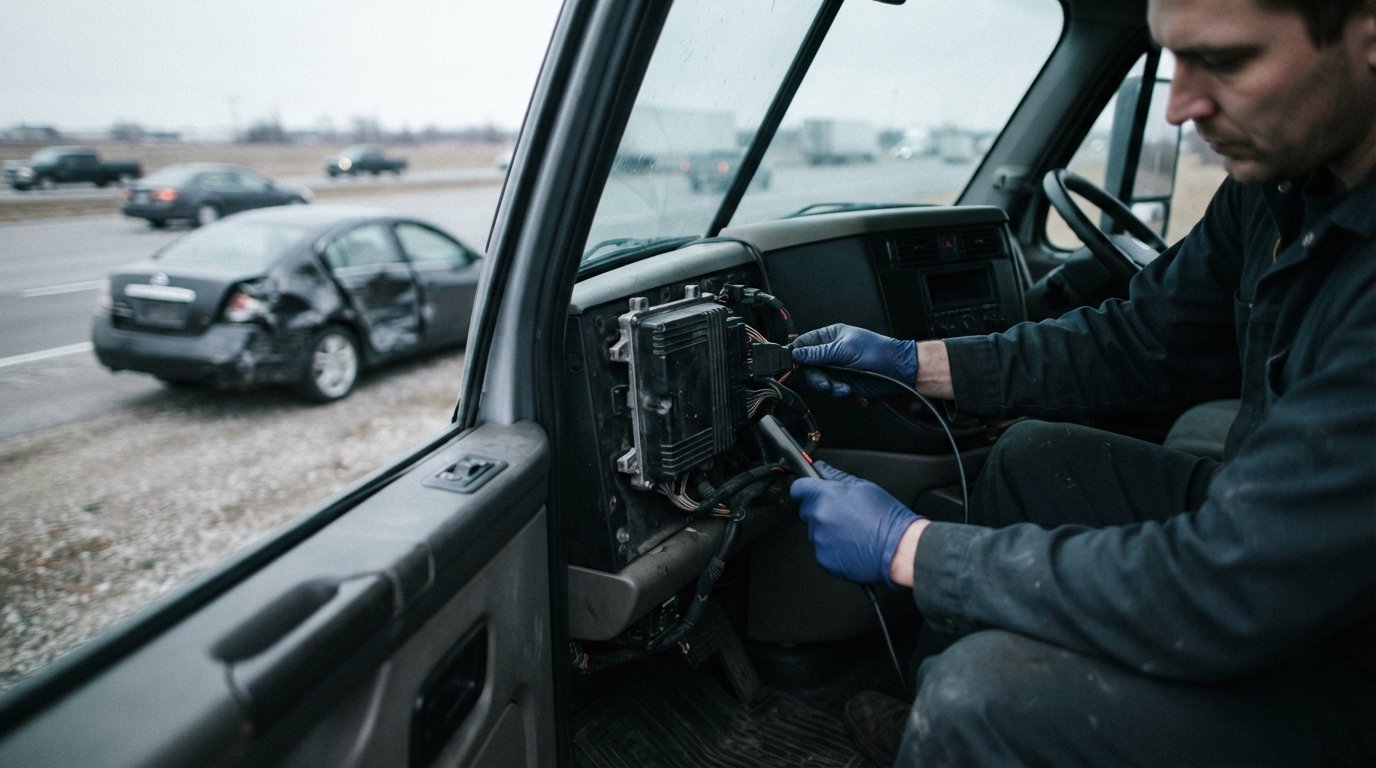
Truck Accident Black Box Data: Why It Matters
Truck accident black box data can preserve speed, braking, and hours-of-service facts. Call (855)-545-2917 for a free, confidential case review.

By Owen Ingram
When a commercial tractor trailer weighing up to 80,000 pounds collides with a passenger vehicle, the physical evidence at the scene tells only part of the story. The most revealing witness is often a small electronic module bolted inside the cab, quietly recording speed, braking, steering input, and driver behavior in the seconds before impact. That module, commonly called a truck accident black box, can preserve facts that no human memory can reliably reproduce. Understanding what truck accident black box data and why it matters means recognizing that this electronic evidence can shape the entire trajectory of a personal injury claim, from the initial insurance demand to a jury verdict.
For crash victims and their families, the window to capture this data is short and unforgiving. Many electronic systems overwrite themselves on a rolling basis, sometimes within days. Trucking companies and their insurers know this, and their legal teams often move quickly to secure or shield the data. The sections below explain what these devices record, how preservation works, how federal motor carrier rules interact with state negligence law, and which defenses carriers typically raise when electronic evidence surfaces.
What Event Data Recorders and Electronic Logging Devices Capture
The term black box covers at least two distinct technologies in a commercial truck. The first is the event data recorder (EDR), sometimes called an electronic control module (ECM) or engine control module. The EDR is triggered by a crash or a hard maneuver, and it captures a snapshot of vehicle dynamics in the seconds surrounding the event. The second is the electronic logging device (ELD), which tracks hours of service, vehicle movement, and driver duty status over a longer timeline. Together, these systems create a detailed record that can contradict or confirm witness statements.
An EDR typically preserves pre-crash data at a rate of several samples per second. Depending on the manufacturer and model year, that data may include vehicle speed, engine RPM, throttle position, brake application, steering angle, seat belt status, airbag deployment, and the delta-v, which is the change in velocity during impact. Some newer systems also record forward radar or camera feeds tied to automatic emergency braking and lane departure warnings. For a crash reconstruction expert, these parameters can establish whether the truck driver braked at all, how fast the truck was moving, and whether a collision avoidance system activated before the crash.
An ELD, by contrast, answers a different set of questions. It shows how many hours the driver had been on duty, whether mandatory rest breaks were taken, and whether the driver falsified paper logs. Fatigue is a recurring factor in commercial truck crashes, and ELD records can either support or undermine a claim that the driver was exhausted. The device also logs vehicle motion, so it can reveal whether the truck was moving when the driver claimed to be parked. In litigation, these records often become the centerpiece of a negligent hiring, training, or supervision claim against the carrier.
The practical takeaway is that black box data is not a single file. It is a collection of electronic records generated by different systems, each with its own retention schedule and accessibility quirks. A thorough investigation may require downloading the EDR, pulling ELD logs, obtaining telematics data from the carrier's fleet management system, and reviewing dashcam footage if the truck was equipped with cameras. Missing one source can leave a gap that the defense exploits at trial.
Why Prompt Preservation Letters and Spoliation Concerns Arise
Electronic evidence is fragile in a way that physical evidence is not. A damaged bumper stays damaged until someone moves it. A black box, however, may continue recording over old data every time the truck is started, and many fleets routinely purge telematics data after a set period. Once the data is overwritten or deleted, it is usually gone for good. That reality is why attorneys send spoliation letters, also called preservation letters, as early as possible after a truck crash.
A preservation letter is a formal written demand telling the trucking company, its insurer, and any third-party maintenance or telematics vendors to retain specific records. It puts the carrier on notice that litigation is reasonably anticipated, which triggers a legal duty to preserve relevant evidence. If the carrier destroys the data after receiving that notice, the court may impose sanctions, allow an adverse inference instruction, or even dismiss defenses. The letter itself does not recover the data, but it creates a paper trail that can be used if the carrier fails to comply.
Timing is critical because different data sources have different retention windows. A typical sequence looks like this:
- Within 24 to 72 hours: The EDR may still hold pre-crash data, but the truck may be repaired, sold, or returned to service, risking overwrite.
- Within 7 to 14 days: ELD and telematics data may be automatically archived or purged depending on the carrier's data plan.
- Within 30 days: Driver qualification files, maintenance records, and dispatch logs may be consolidated or moved to offsite storage.
- Beyond 30 days: Dashcam footage and GPS tracking data may be overwritten if not downloaded.
Because these windows vary by carrier and by device, a prompt preservation letter should be broad rather than narrow. It should request the EDR download, ELD logs, telematics reports, dashcam video, driver personnel files, maintenance and inspection records, hours-of-service records, and any internal crash investigation reports. Overly narrow letters invite arguments that certain records were never covered by the demand.
Spoliation disputes are common in trucking litigation because carriers often control the evidence and have strong incentives to minimize exposure. A carrier might argue that the data was deleted in the ordinary course of business, that the truck was sold before the letter arrived, or that the specific module was not covered by the request. Courts weigh the carrier's culpability, the prejudice to the injured party, and whether a lesser sanction will suffice. In severe cases, a finding of spoliation can shift the burden of proof or support a separate claim for intentional destruction of evidence.
For injured people, the lesson is straightforward: do not wait for the insurance company to volunteer black box data. By the time a claim is filed, the most valuable evidence may already be gone. An attorney who understands trucking litigation can issue preservation demands immediately and, if necessary, seek a court order compelling the download.
Federal Motor Carrier Rules Versus State Negligence Standards
Truck accident cases occupy an unusual legal space because they involve both federal regulations and state tort law. The Federal Motor Carrier Safety Administration (FMCSA) sets rules for commercial driver's licenses, hours of service, vehicle maintenance, drug and alcohol testing, and electronic logging device requirements. These rules establish a baseline of conduct for carriers operating in interstate commerce. State negligence law, meanwhile, determines whether a particular violation caused the plaintiff's injuries and who is liable.
The interaction between the two is not always simple. A violation of an FMCSA rule, such as exceeding the maximum driving time or failing to conduct a required inspection, can be introduced as evidence of negligence in a state court case. Many states apply the doctrine of negligence per se, which means that a violation of a safety statute or regulation is treated as negligence as a matter of law if the plaintiff belongs to the class the rule was designed to protect and the injury is the type the rule was meant to prevent. Truck accident plaintiffs often fall within that class, which makes federal regulatory violations powerful tools.
However, federal rules do not replace state standards. A carrier might comply with every FMCSA requirement and still be negligent under state law for, say, hiring a driver with a history of reckless driving or failing to train a driver on a known hazard. Conversely, a technical regulatory violation might not automatically establish liability if the plaintiff cannot show causation. Courts also must navigate preemption arguments, in which carriers claim that federal law displaces state-law claims. Most courts have rejected broad preemption in trucking cases, but the issue can arise in specific contexts such as equipment standards or hours-of-service enforcement.
For crash victims, the practical significance is that evidence of federal rule violations can strengthen a claim, but it is not a substitute for proving negligence under state law. A successful case typically combines regulatory evidence with traditional tort elements: duty, breach, causation, and damages. That is one reason truck accident claims differ from ordinary car crash cases, as we explain in our guide on truck accident claim differences from car crash cases. The presence of a commercial carrier, federal regulations, and multiple layers of insurance often makes the process more complex than a typical two-driver collision.
Common Defenses Raised by Trucking Carriers and Insurers
When black box data surfaces in a truck accident case, carriers and their insurers rarely concede fault. Instead, they deploy a set of familiar defenses aimed at shifting blame, undermining causation, or limiting damages. Understanding these defenses helps injured people and their attorneys anticipate the opposition and build a stronger record.
One common defense is that the plaintiff caused or contributed to the crash. Carriers may argue that the passenger vehicle cut off the truck, braked suddenly, or was in the truck's blind spot. Black box data can rebut these claims by showing the truck's speed, braking timing, and steering input. If the EDR shows the truck driver never applied the brakes despite having time to react, the comparative fault argument weakens considerably.
Another defense focuses on the reliability of the data itself. Carriers may challenge the calibration of the EDR, the methodology used to download it, or the chain of custody. They might argue that the data was corrupted, that the download tool was outdated, or that the expert interpreting the data lacks proper qualifications. These attacks are why it is important to use a qualified crash reconstruction expert and to document every step of the data recovery process.
Carriers also raise defenses related to the driver's status. They may claim the driver was an independent contractor rather than an employee, which can insulate the carrier from vicarious liability. They may argue that the driver was off duty at the time of the crash or that the trip was outside the scope of employment. ELD records and dispatch logs often undercut these arguments by showing that the driver was on duty and acting within the carrier's business.
Finally, insurers frequently dispute the nature and extent of the plaintiff's injuries. They may hire their own medical experts to argue that the injuries pre-existed the crash or were not as severe as claimed. Black box data can help here too, because a high-impact collision with significant delta-v makes it harder to argue that the plaintiff could not have been seriously hurt. The data provides an objective anchor for damages arguments that might otherwise rest on subjective symptom reports.
For anyone navigating these defenses, having experienced legal representation matters. A free, confidential case review can help clarify what evidence exists, what deadlines apply, and how to proceed. Submitting a form or calling a legal resource does not create an attorney-client relationship, and no one is obligated to hire a lawyer, but an early conversation can prevent irreversible loss of evidence.
How Black Box Data Shapes the Claims Process
Black box data influences every stage of a truck accident claim, from the initial investigation to settlement negotiations and trial. In the early phase, it helps attorneys determine whether a claim is viable and which parties to name as defendants. A carrier might be liable for the driver's negligence, but it could also face direct liability for negligent hiring, training, supervision, or maintenance. The data often reveals which theory is strongest.
During discovery, black box records become exhibits that experts rely on to reconstruct the crash. A reconstruction expert can use speed, braking, and steering data to create animations or diagrams that show exactly what happened. These visuals are persuasive to juries because they are based on objective measurements rather than witness recollection. Insurers know this, which is why they often adjust their settlement positions once clear black box evidence is presented.
At trial, the data can be used to impeach inconsistent testimony. If a driver claims to have been driving the speed limit but the EDR shows otherwise, the jury's perception of the driver's credibility shifts. If the carrier claims the driver was well rested but the ELD shows hours-of-service violations, the jury may infer a pattern of unsafe practices. These credibility attacks can be decisive in close cases.
It is also worth noting that black box data can cut both ways. If the data shows the plaintiff was speeding or distracted, the defense will use it to argue comparative fault. That is why an attorney needs to review the data carefully before relying on it and should be prepared to contextualize it within the broader facts of the crash.
For consumers researching legal options, resources like AttorneyLawsuit provide general information about attorney-related lawsuits and legal disputes, which can be useful background when evaluating representation. The key point is that electronic evidence is powerful but neutral. How it is used depends on the skill and preparation of the legal team handling the case.
Practical Steps to Protect Black Box Evidence After a Truck Crash
Injured people and their families can take several practical steps to protect black box evidence, even before an attorney is involved. The most important step is to act quickly. The longer a case goes without a preservation demand, the greater the risk that critical data is overwritten or deleted.
A useful framework for protecting evidence includes the following actions:
- Document the truck's identifying information, including the USDOT number, license plate, and carrier name, as soon as possible after the crash.
- Preserve any dashcam or phone footage from witnesses and avoid deleting text messages or call logs from the day of the crash.
- Contact an attorney promptly so that a spoliation letter can be sent to the carrier, insurer, and telematics vendors.
- Request that the truck be inspected before it is repaired or returned to service, and ask that the EDR be downloaded by a qualified expert.
- Keep a written log of all communications with insurance adjusters, including dates, names, and what was discussed.
These steps do not guarantee that every piece of data will be recovered, but they significantly improve the odds. They also create a record that can support sanctions if the carrier fails to preserve evidence. In some cases, a court order may be necessary to compel the download of an EDR or the production of telematics data, and an attorney can pursue that remedy.
It is also important to avoid signing anything from the carrier's insurer without legal review. Early settlement offers may be based on incomplete information, and once a release is signed, the claim is usually over. Black box data can change the value of a claim dramatically, so accepting a quick offer before the data is analyzed can be a costly mistake.
The stakes in truck accident cases are high because the injuries are often severe and the damages can be substantial. Black box data levels the playing field by giving crash victims access to the same electronic evidence that carriers use to defend themselves. Without it, a case may rest on memory and inference. With it, a case can rest on measurements and facts.
If you or someone you love was hurt in a commercial truck crash, do not assume the evidence will take care of itself. The data exists, but it will not wait. Reach out for a free, confidential case review, ask questions about preservation, and make an informed decision about how to proceed. Truck accident black box data and why it matters is not just a technical question; it is often the difference between a claim that stalls and a claim that succeeds.