
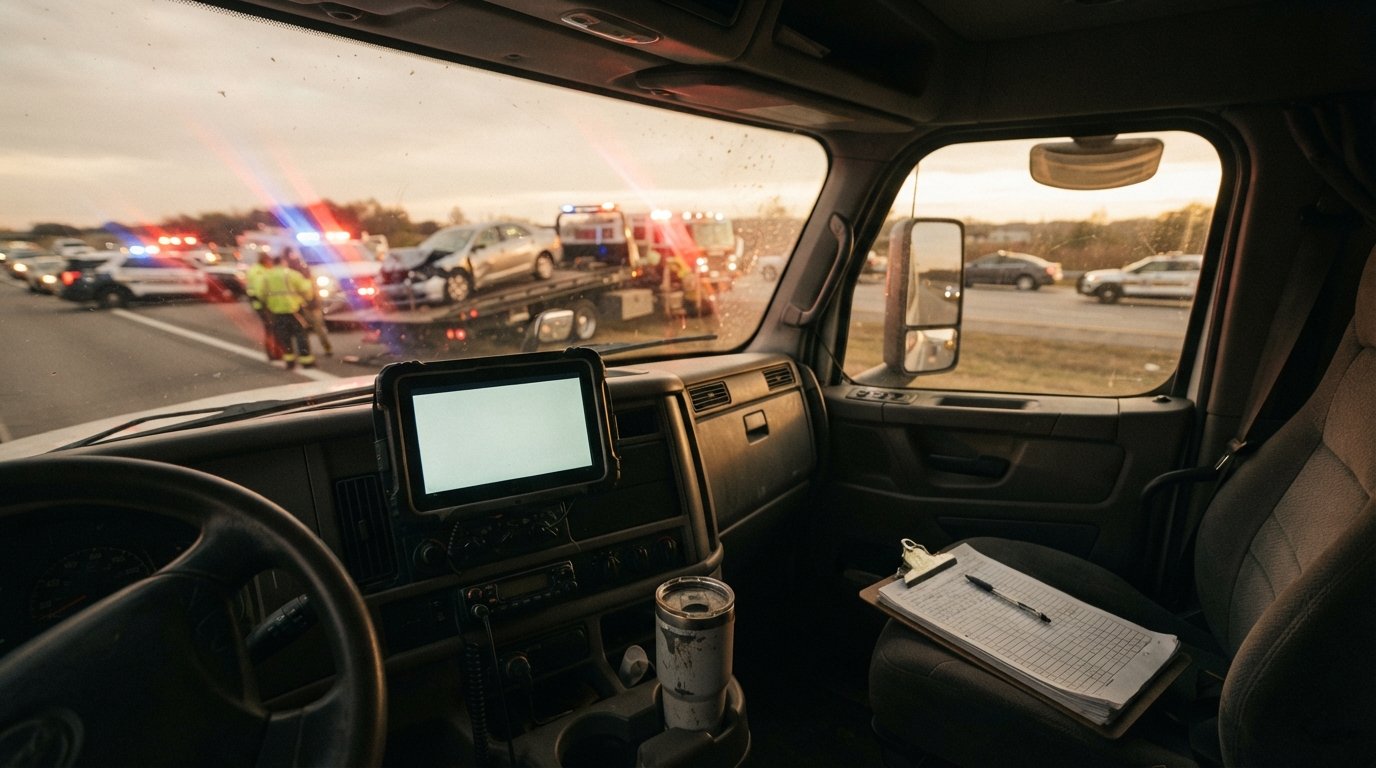
Commercial Vehicle Driver Hours of Service Records in a Crash
Learn how commercial vehicle driver hours of service records in a crash can prove fatigue and fault. Call (855)-545-2917 for a free case review.

When a commercial truck crashes into a passenger car, the physical damage tells only part of the story. The real explanation for why the driver failed to stop, drifted into your lane, or misjudged a turn often lives in the driver's hours of service records. These logs, whether paper or electronic, document how long the driver was behind the wheel, when they rested, and whether they were legally fit to drive. In the chaotic days after a crash, those records can be altered, overwritten, or quietly deleted. Understanding what they contain and how to preserve them is one of the most valuable steps an injury victim can take.
What Hours of Service Rules Require of Commercial Drivers
Federal hours of service regulations, enforced by the Federal Motor Carrier Safety Administration, set strict limits on how long commercial drivers may operate their vehicles. These rules exist because drowsy driving kills. For property-carrying drivers, the core limits include a maximum of 11 hours of driving after 10 consecutive hours off duty, a 14-hour on-duty window that cannot be extended by breaks, and a required 30-minute interruption after 8 cumulative hours of driving. Drivers must also take a 10-hour off-duty period between shifts and adhere to weekly caps of 60 hours over 7 days or 70 hours over 8 days.
These numbers matter in a crash because they create a paper trail of legal compliance or violation. If a driver was on hour 13 of driving when the collision occurred, that single fact can transform a routine negligence claim into a case built on regulatory violation. Juries tend to view hours of service breaches seriously, especially when fatigue is a plausible factor. The records themselves, whether handwritten logs or electronic files, become the primary evidence of whether the driver and the motor carrier followed the law.
It is important to note that exceptions and exemptions exist for certain operations, such as short-haul drivers or agricultural haulers. A skilled attorney will review the specific exemption status of the driver and carrier before drawing conclusions. The key takeaway for crash victims is that hours of service records are not obscure paperwork; they are central proof of driver fitness and carrier oversight.
How Electronic Logging Device Data Gets Preserved
Most commercial trucks on the road today are equipped with electronic logging devices, or ELDs, which automatically record driving time, engine hours, vehicle movement, and location. Unlike paper logs, which can be easily falsified or lost, ELD data is timestamped and harder to manipulate. However, that does not mean it is safe. ELD data can be overwritten after a set retention period, and some systems allow drivers or carriers to edit certain fields. Without a formal preservation demand, critical data may disappear within weeks or even days.
Preserving ELD data requires identifying the specific device and software used by the carrier, then sending a litigation hold notice that compels the carrier to retain all relevant electronic files. This includes not only the hours of service logs themselves but also metadata, audit trails, and any edits made to the records. An experienced attorney may also seek data from the ELD manufacturer or third-party telematics provider if the carrier is uncooperative. In our guide on gathering evidence after a commercial vehicle crash, we explain how this preservation process fits into the broader investigation.
Time is the enemy. Many ELD systems retain detailed data for only six months, and some carriers purge driver logs even sooner. A spoliation letter, which formally demands preservation of evidence, should go out as soon as possible after a crash. Waiting even a few weeks can mean the difference between a clear record of fatigue and a blank screen where the truth used to be.
The Spoliation Letter and Why Speed Matters
A spoliation letter is a formal written demand sent to the motor carrier, and sometimes to the driver, requiring them to preserve all evidence related to the crash. It puts the carrier on notice that a lawsuit is likely and that destroying records could result in legal sanctions. Courts take spoliation seriously; if a carrier destroys hours of service records after receiving a preservation letter, a judge may instruct the jury to presume those records would have been unfavorable to the carrier.
The letter should be sent by certified mail or another trackable method, and it should be specific. It must identify the driver, the vehicle, the date of the crash, and the categories of evidence to be preserved: ELD files, paper logs, dispatch records, maintenance records, driver qualification files, and any internal communications about the driver's schedule. Sending a broad, vague letter is better than nothing, but a precise demand leaves less room for a carrier to claim confusion.
Why does speed matter so much? Because evidence disappears on a schedule. ELD data may be overwritten automatically. Paper logs can be lost in a stack of paperwork. Dispatch records may be archived and deleted. The sooner the letter goes out, the more likely the critical records will still exist when the attorney requests them. In practice, a spoliation letter should be sent within days of the crash, not weeks.
How a Log Violation Supports a Negligence Claim
In a personal injury lawsuit, the plaintiff must prove that the driver or carrier was negligent and that the negligence caused the crash. Hours of service violations can support that claim in several powerful ways. First, a violation is evidence of negligence per se in many jurisdictions, meaning the driver is presumed to have breached a legal duty of care. Second, even without a per se instruction, a log violation is strong circumstantial evidence that the driver was fatigued, distracted, or rushed.
Consider a common scenario: a truck driver has been on duty for 16 hours when he rear-ends a car stopped in traffic. His ELD shows no 30-minute break after 8 hours of driving. That single data point supports an argument that the driver was impaired by fatigue and that the carrier failed to enforce rest rules. The carrier may also face direct liability for negligent scheduling, hiring, or supervision if it pressured the driver to violate the rules. This is why hours of service records are not just about the driver; they expose the carrier's safety culture.
To prove negligence, the plaintiff's attorney will typically rely on a combination of evidence: the ELD or paper logs, the driver's deposition testimony, dispatch communications, and expert testimony about fatigue and driving performance. A log violation does not automatically win the case, but it shifts the burden and gives the jury a clear, understandable reason to find fault. For injury victims, that can mean the difference between a low settlement offer and a fair recovery.
If you are unsure whether your crash involved a commercial vehicle with hours of service issues, a free case review can help clarify your options. Services like CheapInjuryLawyer connect injury victims with attorneys who handle truck crash claims, often on a contingency basis, so you can get guidance without upfront cost.
What Crash Victims Should Do to Protect Log Evidence
The actions you take in the first days after a commercial vehicle crash can determine whether hours of service records survive. You do not need to be a lawyer to take protective steps, but you do need to be organized and prompt. The following checklist can help you preserve the evidence that matters most:
- Write down the truck's DOT number, license plate, and carrier name from the side of the cab or trailer.
- Ask the responding officer to note the carrier and driver information in the crash report, and request a copy as soon as it is available.
- Do not discuss the crash with the carrier's insurance adjuster or investigators without legal advice.
- Contact an attorney promptly so a spoliation letter can be sent to the carrier before records are purged.
- Keep your own medical records, photos, and witness contact information in a single file.
These steps are simple, but they are time-sensitive. Carriers have teams of investigators and adjusters who begin working immediately after a crash. Without a comparable effort on your side, critical evidence like ELD data may never see the light of day. An attorney can send a preservation demand, request the records formally, and bring in experts to interpret them.
Common Defenses Carriers Raise Against Log Evidence
Motor carriers and their insurers rarely accept a log violation without a fight. They may argue that the records were incomplete, that the driver was operating under a valid exemption, or that the violation did not cause the crash. They may also blame the driver as a rogue employee, hoping to avoid direct liability for the company. Some carriers will produce altered or cleaned-up logs, which is why metadata and audit trails matter so much.
Another common defense is to challenge the reliability of ELD data, claiming a device malfunction or calibration error. Plaintiff's attorneys counter these arguments by obtaining the device's technical specifications, maintenance records, and any manufacturer notices about known issues. The goal is to show that the log violation is real, documented, and consistent with other evidence like dispatch messages, fuel receipts, and toll records.
Understanding these defenses helps crash victims and their families ask the right questions. If a carrier claims the driver was off duty, the ELD data should show when the engine was running and when the truck moved. If the carrier claims an exemption, the attorney can check whether the driver's operation actually qualified. The paper trail is rarely perfect, but it is almost always more reliable than memory or self-serving testimony.
Why Hours of Service Records Matter Beyond Liability
Hours of service records also play a role in damages and settlement value. A documented pattern of fatigue violations suggests a carrier that prioritizes schedules over safety, which can support a claim for punitive damages in some cases. Even without punitive damages, a clear log violation strengthens the plaintiff's negotiating position. Insurers know that juries dislike trucking companies that break rest rules, and they adjust their offers accordingly.
For families who have lost a loved one in a commercial vehicle crash, the records can also provide answers. They may reveal that the driver had been on the road for 18 hours or that the carrier had a history of scheduling violations. Those facts do not bring anyone back, but they can support accountability and prevent future crashes. In that sense, hours of service records serve both the individual case and the broader goal of highway safety.
Finally, it is worth remembering that fault rules, insurance requirements, and filing deadlines vary by state. A claim that is strong in one jurisdiction may face different procedural hurdles in another. That variability is one reason why consulting with an attorney who knows trucking law in your state is so important. A free, confidential case review can help you understand what evidence exists and what steps to take next.
The hours of service records in a commercial vehicle crash are more than bureaucratic files. They are the memory of the driver's day, the carrier's safety practices, and often the clearest proof of what went wrong. Preserving them quickly and understanding their role in a negligence claim can make a real difference in the outcome of an injury case.