
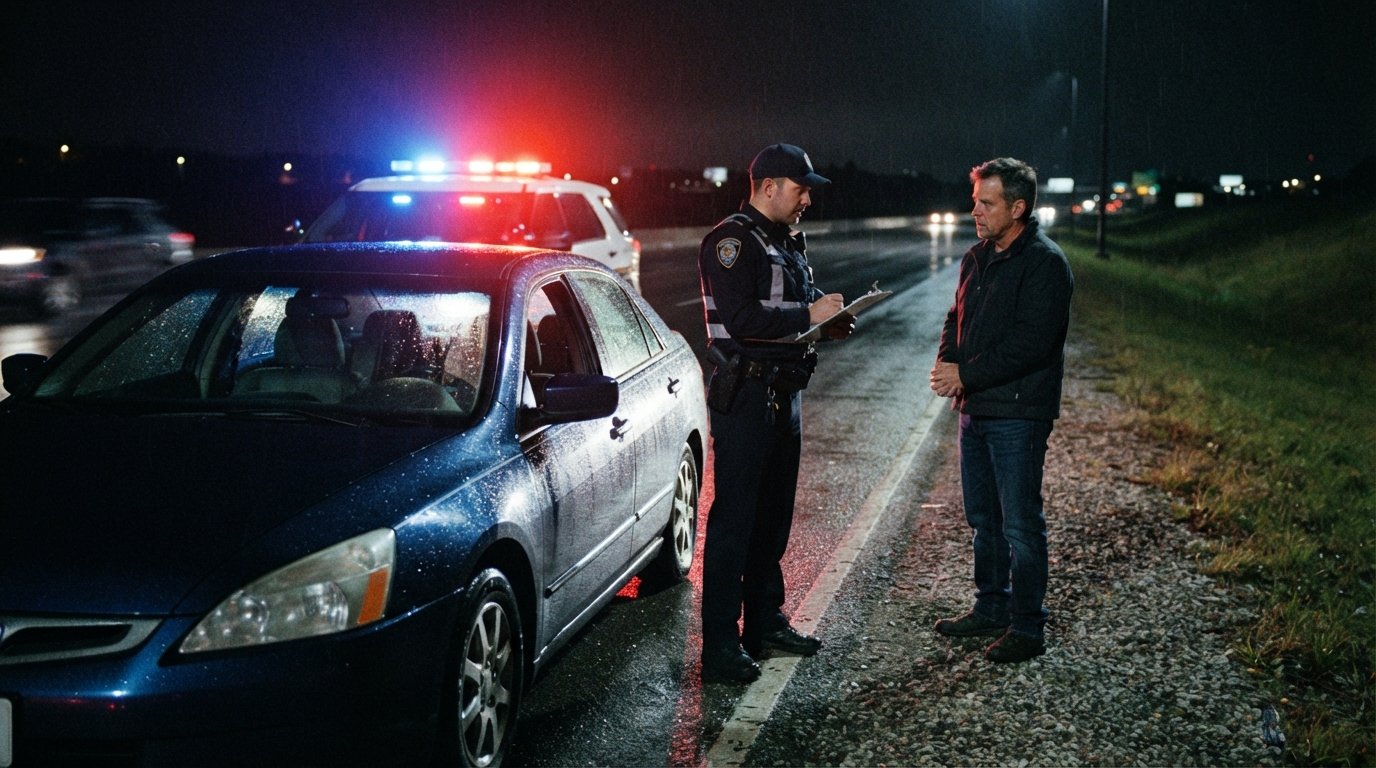
Field Sobriety Test at a Traffic Stop: Can I Refuse?
Can you refuse a field sobriety test at a traffic stop? Learn the consequences and next steps. Call (855)-545-2917 for a free case review.

The officer's lights flash in your rearview mirror, and your heart sinks. After pulling over, the officer asks you to step out of the car and perform a series of roadside exercises. You may wonder: field sobriety test at a traffic stop can I refuse and what happens next? The short answer is that in most states you can decline the physical tests, but the decision carries consequences that vary widely depending on where you are and what happens afterward. Understanding the difference between field sobriety tests and chemical tests, knowing your rights, and recognizing how refusal may be used against you can help you make an informed choice during a stressful encounter.
What Are Field Sobriety Tests and Why Do Officers Use Them?
Field sobriety tests (FSTs) are a set of physical and cognitive exercises that law enforcement officers use to estimate whether a driver is impaired. The most commonly administered battery is the Standardized Field Sobriety Test (SFST), developed by the National Highway Traffic Safety Administration (NHTSA). It includes three components: the horizontal gaze nystagmus (HGN) test, the walk-and-turn, and the one-leg stand. Officers may also use non-standardized tests such as counting backward, reciting the alphabet, or touching finger to nose.
These tests are not designed to measure alcohol concentration precisely. Instead, they rely on divided attention tasks that are supposedly difficult for impaired individuals to perform. However, they are subjective. An officer's interpretation of your performance can be influenced by factors unrelated to alcohol or drugs, including fatigue, medical conditions, age, weight, footwear, and nervousness. This subjectivity is one reason many defense attorneys scrutinize FST results closely.
Officers use FSTs to build probable cause for an arrest. If you perform poorly, the officer may arrest you and then request a chemical test (breath or blood) to measure your blood alcohol concentration (BAC). The FST itself is not a chemical test and does not produce a numerical result. It is simply an observational tool.
Can You Refuse a Field Sobriety Test?
Yes, in most states you can refuse to perform field sobriety tests. Unlike chemical tests, which are governed by implied consent laws, field sobriety tests are typically voluntary. The officer may ask you to perform them, but you are generally not required to comply. However, refusing is not without risk. In many jurisdictions, the officer can use your refusal as evidence of consciousness of guilt or as a factor in establishing probable cause for arrest. Some states explicitly allow prosecutors to mention your refusal at trial.
It is important to distinguish between refusal of field sobriety tests and refusal of chemical tests. Implied consent laws apply to chemical tests, not usually to FSTs. When you obtain a driver's license, you implicitly agree to submit to a breath or blood test if arrested for DUI. Refusing a chemical test can lead to automatic license suspension and other penalties, even if you are never convicted of DUI. Field sobriety tests, by contrast, are not covered by implied consent in most states, but the consequences of refusal still vary.
Because state rules differ, there is no one-size-fits-all answer. In some states, refusing FSTs is a relatively low-risk way to avoid giving the officer additional evidence. In others, the refusal itself can be used against you. Before making a decision, it helps to understand your state's specific laws. If you are unsure, you can politely decline and ask to speak with an attorney. Remember that you have the right to remain silent and the right to an attorney, though the officer may not allow you to call one before deciding whether to submit to chemical testing.
The Critical Difference Between Field Sobriety Tests and Chemical Tests
The distinction between field sobriety tests and chemical tests is central to understanding your rights at a traffic stop. Field sobriety tests are the roadside exercises (walk-and-turn, one-leg stand, HGN) that officers use to gauge impairment. Chemical tests are breath, blood, or urine tests that measure BAC or the presence of drugs. The legal rules for each are different.
Implied consent laws apply to chemical tests. By driving on public roads, you consent to chemical testing if lawfully arrested for DUI. If you refuse, the state can suspend your license and may introduce the refusal as evidence in court. The exact penalties for chemical test refusal vary by state, but they often include a longer license suspension than a DUI conviction would impose, plus fines and mandatory education or treatment programs. In some states, a first refusal can result in a one-year suspension.
Field sobriety tests are not typically subject to implied consent. They are voluntary in most states, meaning you can decline without automatic license suspension. However, the officer may still arrest you based on other observations (erratic driving, slurred speech, odor of alcohol, admissions). Once arrested, you will face the chemical test decision. At that point, refusing the chemical test triggers implied consent penalties.
This difference is why many legal guides advise that you should refuse field sobriety tests but think carefully before refusing a breath or blood test. For a deeper look at that specific trade-off, see this guide on whether to refuse a field sobriety test but not a breath test and the DUI consequences that follow.
How Refusal Can Be Used as Evidence
In many states, prosecutors can use your refusal to perform field sobriety tests as evidence of guilt. The theory is that an innocent person would have no reason to decline. However, courts and legislatures have taken different approaches. Some states allow the refusal to be mentioned at trial, while others prohibit it or limit how it can be used. In some jurisdictions, the officer can testify that you refused, but the prosecutor cannot argue that the refusal shows consciousness of guilt.
Even where refusal is not admissible as direct evidence, it can still affect the officer's probable cause determination. If you decline the FSTs, the officer may rely more heavily on other observations, such as erratic driving, bloodshot eyes, or an admission that you had been drinking. That can lead to arrest, which then triggers the chemical test request. In that sense, refusing FSTs does not necessarily prevent arrest; it simply changes the evidence the officer uses.
Additionally, some states treat refusal of field sobriety tests as a civil traffic infraction or impose other administrative penalties. For example, a few states have laws that allow license suspension for refusing FSTs, though this is less common than for chemical test refusal. Because the rules are state-specific, it is important to know your state's approach before you are in the situation.
Immediate Steps to Take After a Traffic Stop
If you are pulled over and suspected of DUI, your actions in the first few minutes can shape the rest of the case. Staying calm and polite is essential. You are not required to answer questions beyond identifying yourself (and in some states, providing registration and insurance). You can politely decline to answer questions about how much you have had to drink or where you are coming from. You can also decline to perform field sobriety tests, but you should do so respectfully.
Here are practical steps to consider:
- Stay in the vehicle unless the officer asks you to step out. Keep your hands visible and avoid sudden movements.
- Provide your license, registration, and proof of insurance when requested. In most states, you are legally required to do so.
- Politely decline to answer questions about drinking or drug use. You can say, "I prefer not to answer that."
- If asked to perform field sobriety tests, you can decline. You might say, "I respectfully decline to perform the tests."
- If arrested and asked to take a chemical test, ask to speak with an attorney before deciding, though the officer may not permit a call before testing. Understand that refusing the chemical test triggers implied consent penalties.
After the stop, document everything you remember as soon as possible: the time, location, officer's name and badge number, the questions asked, and your responses. Note any statements you made and any tests you were asked to perform. If you refused, note exactly what you said. This documentation can be valuable for your attorney. Also, preserve any dashcam or bodycam footage if available, and gather contact information for any witnesses.
If you are facing DUI charges, seeking legal representation early is critical. A lawyer can review the stop, the arrest, and the chemical test results to identify defenses. For a free, confidential case review from participating attorneys in your area, you can visit CheapInjuryLawyer, a service that connects injured people and DUI defendants with lawyers who may work on contingency. Remember that submitting a form does not create an attorney-client relationship, and you are never obligated to hire a lawyer.
Why State Rules on Refusal Differ
DUI law is primarily a matter of state law, and each state has its own statutes, court decisions, and administrative regulations. This is why the answer to "can I refuse a field sobriety test" varies so much. Some states have explicit statutes that allow refusal and limit the consequences. Others have case law that permits the refusal to be used as evidence. A few states treat FST refusal as a separate offense or administrative violation.
For example, in California, you can refuse field sobriety tests, but the officer can testify about the refusal in court. In Texas, refusal of FSTs is generally not admissible, but refusal of a breath or blood test can lead to license suspension. In Florida, refusal of FSTs is also generally voluntary, but the officer can consider it as part of probable cause. These are just a few examples; the nuances are extensive.
Because the rules are so varied, it is impossible to provide blanket advice that applies everywhere. If you are facing a DUI charge or want to know your rights before a stop, consult a local DUI attorney. They can explain your state's specific rules on field sobriety tests, chemical tests, and implied consent. They can also help you understand how a refusal might affect your case and your driver's license.
What Happens Next After Refusing a Field Sobriety Test
If you refuse field sobriety tests, the officer may still arrest you if they have probable cause based on other evidence. After arrest, you will be taken to a police station or hospital for a chemical test. At that point, you face the implied consent decision. If you refuse the chemical test, the officer will typically seize your license and issue a temporary permit. You will have a limited time (often 7 to 10 days) to request a hearing to challenge the suspension. The exact process varies by state.
Your case will then proceed through the criminal justice system. The prosecution may use your FST refusal as evidence if state law allows. Your attorney can challenge the admissibility of the refusal, the legality of the stop, and the accuracy of any chemical test. They can also negotiate with the prosecutor for reduced charges or alternative sentencing. In some cases, diversion programs are available for first-time offenders.
It is important to remember that refusing a field sobriety test is not a magic solution. It may limit the evidence against you, but it does not guarantee you will avoid arrest or conviction. The best approach depends on your state's laws and the specific facts of your situation. If you have been arrested for DUI, contact an attorney as soon as possible to protect your rights.
Navigating a DUI stop is stressful, and the decisions you make in the moment can have lasting consequences. Knowing the difference between field sobriety tests and chemical tests, understanding your state's refusal rules, and documenting the encounter can help you make informed choices. If you need legal guidance, consider reaching out to a qualified DUI attorney who can explain your options and advocate for your rights.