
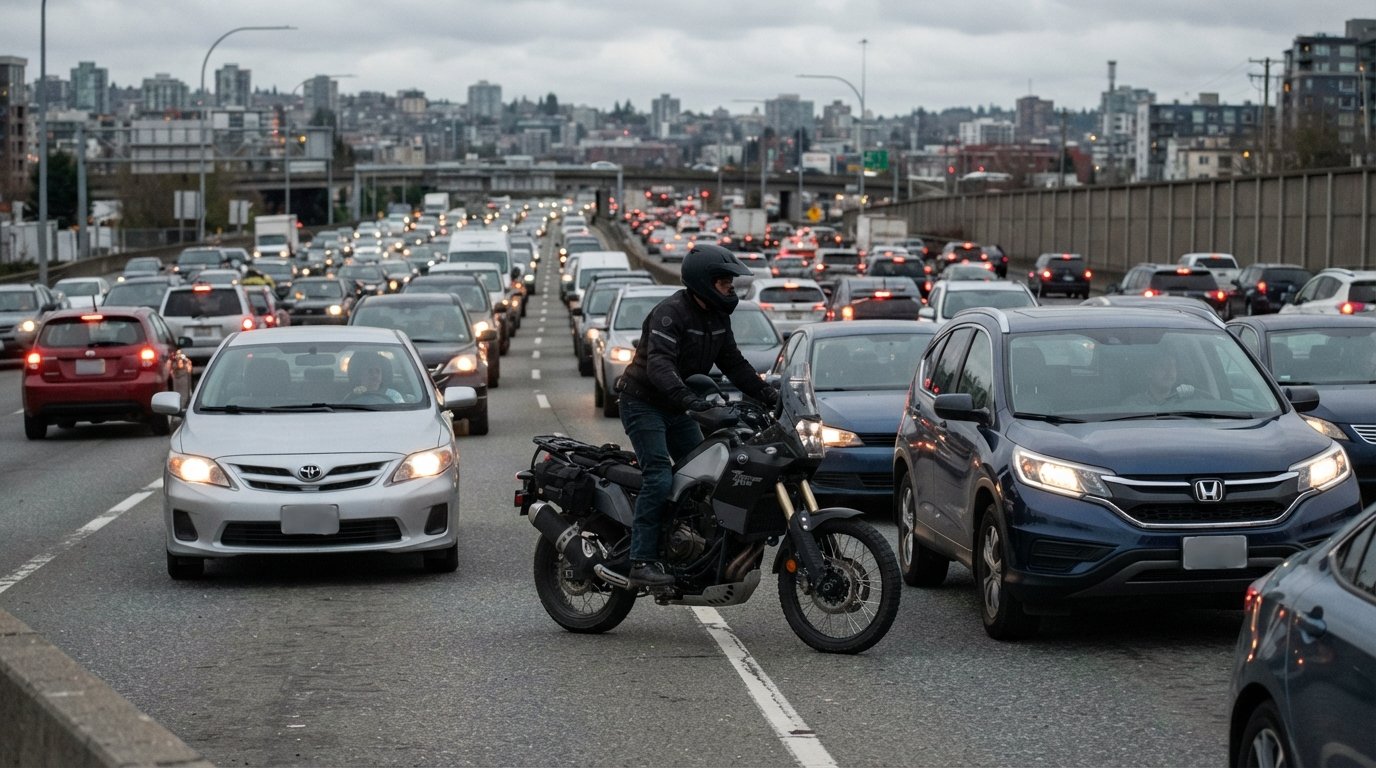
Motorcycle Lane Splitting Accident Claim Rules by State
Motorcycle lane splitting accident claim rules by state can make or break your recovery. Call (855)-545-2917 for a free case review.

By Julia Hayes
Lane splitting remains one of the most misunderstood and legally volatile practices in motorcycling. A rider filtering between lanes at a red light or during slow traffic can be doing something perfectly legal in one state and something that destroys their injury claim in another. For anyone hurt in a lane splitting crash, the outcome often hinges on a single question: did the rider have the legal right to be there? The answer changes dramatically depending on where the collision occurred, how the rider was behaving, and how the insurance company or court interprets the state's vehicle code. This guide breaks down motorcycle lane splitting accident claim rules by state, explains how comparative fault can shrink or eliminate recovery, and shows riders what to document before the tow truck arrives.
Which States Permit Lane Splitting and Which Forbid It
Only a small number of states have passed laws that expressly authorize lane splitting, and even those laws tend to be narrow. California was the first state to formally recognize the practice, and its Vehicle Code allows a motorcycle to travel between rows of stopped or slow-moving traffic in the same direction, provided the rider does so safely and at a speed no more than 10 mph faster than surrounding traffic. Utah followed with a more limited rule that permits filtering between lanes only when traffic is stopped and the motorcycle stays under 15 mph. Montana, Arizona, and a handful of other states have experimented with pilot programs or limited statutory language, but the details matter enormously. In states like these, a rider who exceeds the posted speed threshold or filters through moving traffic outside the statutory window can be treated as negligent even though lane splitting is generally allowed.
Most states, however, do not authorize lane splitting at all. In those jurisdictions, the practice is either explicitly prohibited by statute or treated as an unsafe lane change, careless driving, or failure to maintain a single lane. A rider who splits lanes in a state that forbids the practice is exposed to a traffic citation, a finding of negligence per se, and a sharply reduced injury recovery. The table below summarizes the broad categories so riders can see where they stand, though anyone facing a real claim should verify the current statute with a licensed attorney in that state.
- Expressly permitted with conditions: California, Utah, and a limited number of states with pilot programs or statutory filtering rules.
- Not authorized but not explicitly banned: Some states leave the practice undefined, which means courts and insurers fill the gap through negligence analysis.
- Explicitly prohibited: The majority of states, where lane splitting can be cited as a violation and used against the rider in a claim.
- Locally restricted: A few states allow individual municipalities to regulate or ban the practice, creating patchwork rules within a single state.
This patchwork is exactly why motorcycle lane splitting accident claim rules by state cannot be reduced to a single national rule. A rider who splits lanes legally in Los Angeles may be acting unlawfully the moment they cross into a neighboring jurisdiction with a different local ordinance. Insurance adjusters know this, and they routinely use the rider's location and speed at the moment of impact to argue that the rider assumed the risk of the maneuver. Riders should never assume that because lane splitting felt normal or because other motorcyclists do it every day, the practice is protected where the crash happened.
How Comparative Fault Applies When Splitting Is Illegal
Comparative fault is the legal principle that assigns a percentage of blame to each party in an accident. In a pure comparative fault state, a rider found 40 percent at fault can still recover 60 percent of their damages. In a modified comparative fault state, recovery is barred once the rider's share of fault reaches 50 or 51 percent, depending on the jurisdiction. This distinction is critical in lane splitting cases because the maneuver itself often becomes the centerpiece of the fault argument. If the rider was splitting lanes illegally, the defense will argue that the rider's violation is the primary cause of the crash, pushing the fault percentage above the threshold that allows any recovery at all.
Consider a common scenario: a rider filters between two lanes of slow traffic and a driver suddenly changes lanes without signaling. In a state where lane splitting is legal and the rider was within the statutory speed limit, the driver's failure to signal and failure to check mirrors may carry most or all of the fault. In a state where lane splitting is prohibited, the same crash can flip: the adjuster argues the rider was never supposed to be in that space, so the rider bears a large share of responsibility even though the driver failed to signal. The physical evidence may be identical, but the legal framework produces wildly different claim outcomes.
Comparative fault also interacts with the doctrine of negligence per se. In many states, violating a traffic statute that is designed to protect a class of people (here, other motorists) creates a presumption of negligence. A lane splitting citation can therefore do more than cost the rider a fine; it can hand the insurance company a ready-made liability argument. Riders should expect the adjuster to request the traffic citation, the police report, and any dashcam or helmet camera footage that shows the rider's position relative to the lane markings. Even in permissive states, exceeding the statutory speed differential or filtering through traffic that is moving faster than the law allows can trigger the same negligence analysis.
There is an important counterweight. Comparative fault is not automatic, and riders are not required to accept the adjuster's fault allocation. An attorney can challenge the citation, present evidence that the other driver violated a separate duty (such as an unsafe lane change or failure to yield), and argue that the rider's conduct was reasonable under the circumstances. In some cases, the other driver's conduct is so clearly the proximate cause that the rider's lane position becomes a minor factor. The key is to treat the fault question as contested from the first phone call rather than conceding it because a citation was issued.
What Riders Should Document at the Scene
Evidence gathered in the first minutes after a lane splitting crash often determines whether the claim survives. Memory fades, vehicles get moved, and witnesses leave. Riders who can document the scene thoroughly give their attorney far more to work with when challenging a fault allocation. The following steps should be taken as soon as it is safe to do so, and always before leaving the scene.
- Photograph the lane positions: Capture wide shots showing where the motorcycle and the other vehicle came to rest, the lane markings, and the traffic density. Close-ups of damage and debris help establish impact angles.
- Record the traffic conditions: Note whether traffic was stopped, slow, or moving at speed, and estimate the speed differential between the motorcycle and surrounding vehicles. This is often the single most important fact in a lane splitting claim.
- Collect witness information: Names, phone numbers, and email addresses from independent witnesses, especially drivers who were not involved and can describe what they saw.
- Preserve camera footage: Helmet cams, dashcams, and nearby business surveillance can show the rider's speed and lane position. Request that the other driver preserve their dashcam and ask the responding officer to note any cameras in the report.
- Get medical attention and document symptoms: Even minor injuries can worsen. A medical record created the same day links the crash to the injury and counters later claims that the rider was not hurt.
Riders should also request a copy of the police report and review it carefully for errors. Reports sometimes misstate the rider's lane position or omit the other driver's signal violation. Correcting those errors early, ideally with the help of an attorney, prevents the report from becoming a permanent liability record. If the rider received a citation, the citation should be photographed and preserved along with any court date. That citation will almost certainly surface in the claim, and the rider should not discuss it with the adjuster before speaking with counsel.
Why Riders Should Not Assume Bias Against Them Is Fatal to a Claim
Many motorcyclists believe that insurers and juries are inherently biased against riders, and that a lane splitting crash is a lost cause before it begins. That assumption is understandable but often wrong. Bias exists, but it is not a legal rule, and it can be countered with evidence, expert testimony, and a clear presentation of the other driver's violations. In permissive states, the rider's conduct may be entirely lawful, and the adjuster's suggestion that the rider was reckless is simply an opening negotiation tactic. In restrictive states, the rider may still recover a substantial portion of damages under comparative fault if the other driver's negligence is the dominant cause of the crash.
The more productive mindset is to treat the claim as a fact-driven dispute rather than a foregone conclusion. Riders who document the scene, preserve footage, seek prompt medical care, and avoid recorded statements to the insurer give themselves a real chance to push back on an unfavorable fault allocation. It also helps to understand that insurance companies evaluate claims on risk and cost, not on personal dislike of motorcyclists. A well-supported claim with clear liability evidence is harder to lowball, even when the rider was splitting lanes.
For riders who want a free, confidential review of their situation, a matching service can connect them with a participating personal injury attorney who handles motorcycle crashes in their state. CheapInjuryLawyer.com offers a no-cost case review and attorney matching for injured riders, and it is not a law firm. Submitting a request does not create an attorney-client relationship and does not obligate anyone to hire a lawyer. It is simply a way to get a professional opinion on whether the lane splitting facts help or hurt the claim before speaking with an adjuster.
Riders should also recognize that the other driver's conduct matters as much as their own. A driver who fails to signal, drifts across lane lines, or opens a door into traffic may be liable even if the rider was splitting lanes. In some cases, the other driver's violation of a separate statute creates an independent basis for liability that survives the lane splitting issue. An attorney can evaluate whether the other driver's conduct was the proximate cause and whether the rider's actions were a foreseeable response to that conduct. The analysis is rarely as simple as the adjuster makes it sound.
The rules vary so much by state that riders should never rely on general advice from a forum or a friend who crashed in a different jurisdiction. Motorcycle lane splitting accident claim rules by state determine whether the maneuver is lawful, how fault is allocated, and whether a citation becomes a claim-killer or a manageable detail. Riders hurt in a lane splitting crash should preserve evidence, avoid recorded statements, and get a case review before accepting any settlement offer. The right approach can protect recovery even when the facts are complicated. For a related look at how unexpected medical events affect fault analysis, see this guide on car accident claims when the other driver had a medical emergency, which illustrates how liability can shift when the other driver's conduct is outside the norm.