
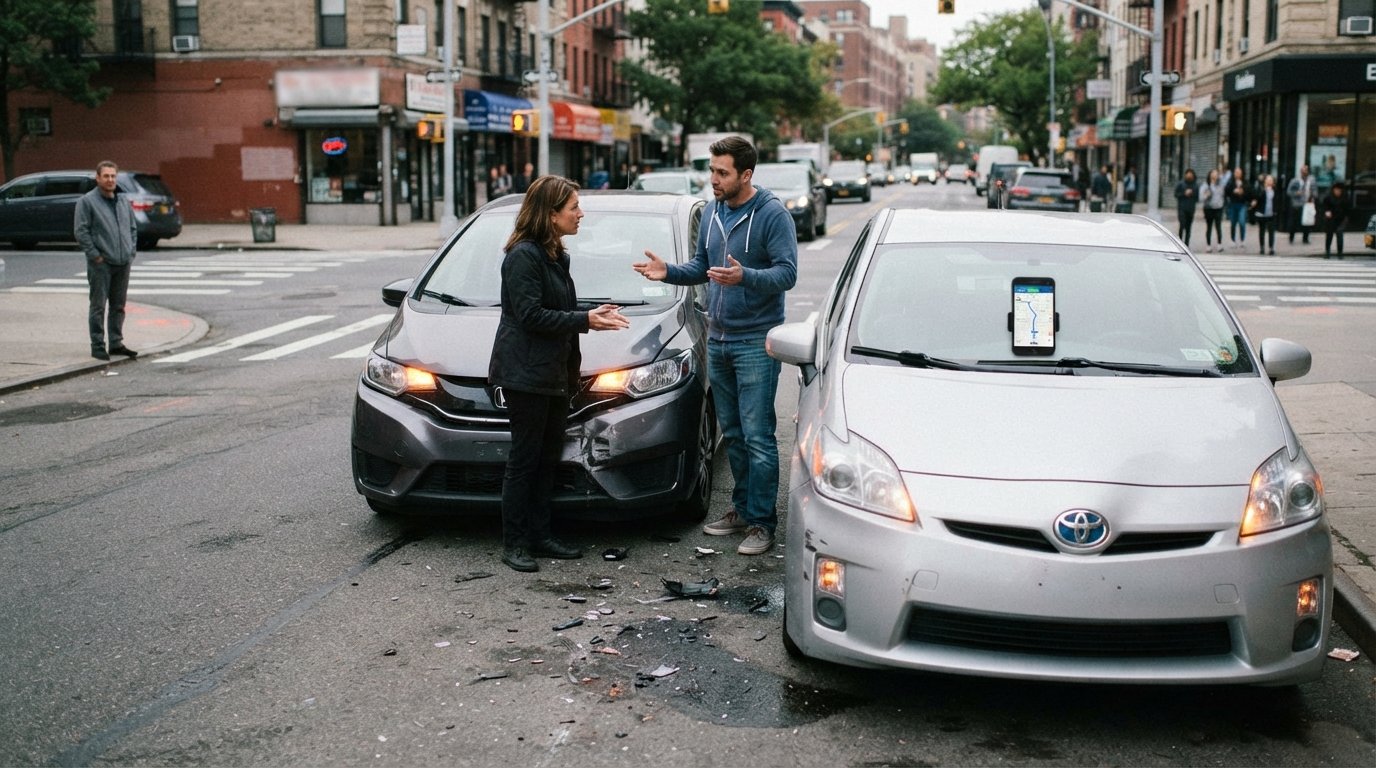
Rideshare Accident: Driver Between Trips? Know Your Rights
Injured in a rideshare accident where the app driver was between trips? Call (855)-545-2917 for a free, no-obligation case review.

By Marcus Hale
You hail a rideshare, watch the driver accept your request, and then see the vehicle pause a block away. The app shows the driver is completing another ride or simply waiting for the next request. Minutes later, a crash happens, and you are injured. The driver insists they were not on an active trip at the moment of impact, which complicates everything. This scenario, a rideshare accident where the app driver was between trips, raises unique legal and insurance questions that can leave injured victims confused about who pays. Understanding the coverage periods, the gap in protection, and the steps you must take can mean the difference between a smooth claim and a financial nightmare.
Rideshare companies like Uber and Lyft divide a driver's time into distinct phases, each with different insurance implications. The period between trips, when the driver is logged into the app but has not yet accepted a new ride request, is often a coverage gray zone. Injured parties may find that the rideshare company denies responsibility, the driver's personal policy may or may not apply, and the path to recovery becomes a puzzle. This article breaks down the three coverage periods, explains why the between-trips window creates a gap, outlines what personal insurance may cover, and emphasizes why prompt notice to every possible insurer is critical. If you or a loved one has been hurt in such an accident, seeking a free case review from a qualified attorney can help you navigate these complexities. Call (855)-545-2917 to speak with a representative who can connect you with legal help.
The Three Coverage Periods in Rideshare Insurance
Rideshare companies typically describe three distinct periods that determine which insurance policy responds after a collision. These periods are based on the driver's status within the app at the time of the accident. Understanding them is the first step in determining liability and pursuing compensation.
Period 1: App On, Waiting for a Request
This is the period when the driver has opened the app and is available to accept rides but has not yet received or accepted a ride request. During this time, the driver's personal auto insurance is usually the primary coverage. Rideshare companies may provide limited contingent liability coverage, but it often kicks in only after the personal policy is exhausted or denies coverage. This period is essentially the between-trips window, and it is where many coverage disputes arise.
Period 2: App On, Ride Accepted, En Route to Pickup
Once the driver accepts a ride request and is on the way to pick up the passenger, rideshare company insurance typically becomes primary. This coverage usually includes liability coverage for third parties and may also provide coverage for the driver and passengers. The limits are often higher than the driver's personal policy, reflecting the commercial nature of the activity.
Period 3: Passenger On Board
When a passenger is in the vehicle, the highest level of rideshare company insurance applies. This period includes liability coverage, uninsured/underinsured motorist coverage, and sometimes personal injury protection or medical payments coverage. The rideshare company's policy is designed to protect passengers and third parties during this active ride phase.
The critical takeaway is that the between-trips period (Period 1) offers the least protection from the rideshare company and relies heavily on the driver's personal insurance. Injured parties often mistakenly assume the rideshare company will cover them simply because the driver was logged into the app, but that is not always the case.
Why the Time Between Trips Is a Coverage Gap
The between-trips period is often called a coverage gap because it falls between the cracks of personal and commercial insurance. Rideshare companies maintain that their commercial policies are not triggered until a ride is accepted or a passenger is on board. Meanwhile, personal auto policies typically exclude coverage for commercial use, including rideshare driving. This leaves the driver, and anyone injured by the driver, in a precarious position.
Consider this example: A driver is logged into the Uber app, waiting for a request in a parking lot. They pull out and strike a pedestrian. The driver's personal policy may deny the claim because the vehicle was being used for rideshare purposes, even though no ride was active. Uber's policy may also deny coverage because the driver was not in Periods 2 or 3. The injured pedestrian is then left to pursue the driver directly, which may be difficult if the driver has limited assets or if the personal insurer rescinds coverage.
This gap is not just a technicality; it has real consequences for accident victims. It means that identifying all possible insurance policies and notifying them promptly is essential. It also means that legal guidance can be invaluable in untangling the web of denials and exclusions.
What Personal Coverage of the Driver May Still Respond
Despite the exclusions for commercial use, the driver's personal auto insurance may still provide some coverage in certain situations. The key is whether the driver's policy includes a rideshare endorsement or whether the insurer treats the between-trips period as non-commercial.
Some auto insurers offer a rideshare endorsement that extends personal coverage to include the between-trips period and sometimes Periods 2 and 3. If the driver has this endorsement, their personal policy may respond, at least up to its limits. Without the endorsement, the insurer may deny coverage entirely, arguing that the driver was engaged in a commercial activity.
Additionally, if the driver was not logged into the app at the time of the accident, their personal policy would likely apply as normal. But in a between-trips scenario, the driver is almost always logged in, which triggers the commercial use exclusion. Injured parties should not assume that the driver's personal policy will automatically cover them; they must investigate the policy language and any endorsements.
It is also worth noting that the driver's personal policy may provide medical payments coverage or personal injury protection for the driver and passengers, regardless of fault, depending on the state and policy. However, these coverages are often limited and may not fully compensate for serious injuries.
Why Prompt Notice to All Insurers Matters
In any car accident, notifying insurers promptly is important, but in a rideshare accident where the driver was between trips, it is absolutely critical. There are multiple potential policies in play: the driver's personal auto policy, the rideshare company's contingent policy, and possibly the injured party's own uninsured/underinsured motorist coverage. Each policy has its own notice requirements and deadlines, and missing one can jeopardize your claim.
Prompt notice serves several purposes. It ensures that the insurer has an opportunity to investigate the accident while evidence is fresh. It also protects your rights under the policy, as late notice can be grounds for denial. In the complex between-trips scenario, you may not know which policy will ultimately respond, so notifying all of them preserves your options.
Here are the key parties to notify after a rideshare accident where the driver was between trips:
- The rideshare company: Report the accident through the app or their website. They will typically acknowledge the report and may provide information about their insurance coverage.
- The driver's personal auto insurer: Obtain the driver's insurance information at the scene if possible, and notify their insurer of the claim. Even if they deny coverage, you want a formal response.
- Your own auto insurer: Notify your insurer about the accident, especially if you have uninsured/underinsured motorist coverage or medical payments coverage. This can provide a safety net if other policies deny coverage.
- Any other involved parties' insurers: If there are other vehicles involved, notify their insurers as well.
Keeping a record of all notifications, including dates, times, and names of representatives, is essential. This documentation can help if disputes arise later.
Steps to Take After a Rideshare Accident Where the Driver Was Between Trips
If you are injured in a rideshare accident where the app driver was between trips, your actions in the immediate aftermath can significantly impact your ability to recover compensation. Here is a step-by-step guide to protect your rights.
1. Ensure Safety and Seek Medical Attention
Your health is the top priority. Call 911 if anyone is injured. Even if you feel fine, see a doctor as soon as possible. Some injuries, like whiplash or internal bleeding, may not be immediately apparent. Prompt medical care also creates a record linking your injuries to the accident.
2. Document the Scene
If you are able, take photos of the vehicles, the damage, the road conditions, and any visible injuries. Collect contact information from the driver, passengers, and witnesses. Ask the driver for their insurance information and note whether they were logged into the rideshare app at the time of the accident. This detail is crucial for determining coverage.
3. Report the Accident to the Rideshare Company
Use the app or the company's website to report the accident. Be honest about what happened and provide as much detail as possible. The company may ask you to provide a statement or submit photos. Keep a copy of all communications.
4. Notify Your Own Insurer
Contact your auto insurer to report the accident, even if you were a passenger or a pedestrian. If you have uninsured/underinsured motorist coverage or medical payments coverage, this step can help you access benefits while other claims are pending.
5. Keep Detailed Records
Maintain a file with all accident-related documents: police reports, medical records, receipts, correspondence with insurers, and notes from conversations. This organized record will be invaluable if you need to prove your claim.
6. Consult with a Personal Injury Attorney
Rideshare accidents involving the between-trips period are legally complex. An experienced attorney can help you identify all potential sources of compensation, navigate insurance denials, and protect your rights. Many personal injury attorneys offer free consultations and work on a contingency fee basis, meaning you pay nothing unless they recover compensation for you.
For a free, confidential case review, consider reaching out to a service like CheapInjuryLawyer.com, which connects injured people with participating attorneys nationwide. They can help you understand your options and avoid surprise bills. Remember, submitting a form does not create an attorney-client relationship, and you are never obligated to hire a lawyer.
If you are unsure where to turn, you can also call (855)-545-2917 to speak with a representative who can guide you through the process of finding legal help.
How Liability Is Determined in Between-Trips Accidents
Liability in a between-trips rideshare accident hinges on several factors, including the driver's status in the app, the applicable insurance policies, and the laws of the state where the accident occurred. Unlike a typical car accident where fault is often clear, these cases require a careful analysis of the coverage periods and policy language.
The rideshare company will likely argue that it is not responsible because the driver was not on an active trip. The driver's personal insurer may argue that the vehicle was being used for commercial purposes, triggering an exclusion. The injured party is then caught in the middle. To determine liability, investigators may review app data, including when the driver logged in, whether they had accepted a ride, and their location history. This data can establish the driver's status at the time of the crash.
In some cases, the rideshare company's contingent liability policy may apply if the driver's personal policy denies coverage. These policies typically provide limited coverage, often up to certain state minimums, but they can be a source of compensation. However, the rideshare company may not voluntarily offer this coverage; it often requires persistence and legal pressure to access.
An attorney can help you navigate these issues by sending spoliation letters to preserve app data, corresponding with insurers, and, if necessary, filing a lawsuit to obtain evidence. Because the laws and insurance regulations vary by state, it is essential to work with someone familiar with the local rules. For a deeper dive into how liability works in rideshare accidents, see our guide on who is liable in a rideshare accident.
Common Defenses and How to Counter Them
Insurance companies and rideshare companies often raise specific defenses in between-trips accident cases. Being aware of these defenses can help you and your attorney anticipate and counter them.
Defense 1: The driver was not on an active trip.
This is the most common defense. The rideshare company will point to its policy language and argue that coverage only applies during Periods 2 and 3. To counter this, you may need to show that the company's contingent policy applies or that the driver's personal policy should respond because the between-trips activity was not commercial in nature. App data and witness statements can help establish the driver's status.
Defense 2: The driver's personal policy excludes commercial use.
The driver's insurer may deny coverage based on a commercial use exclusion. However, some policies have exceptions or endorsements for rideshare driving. Reviewing the policy carefully is essential. If the exclusion is ambiguous, your attorney may argue that it should be interpreted in favor of coverage.
Defense 3: The injured party was at fault.
Insurers often try to shift blame to the injured party to reduce or deny compensation. This is why documenting the scene and obtaining witness statements is so important. An attorney can help you gather evidence to rebut comparative fault allegations.
Defense 4: Pre-existing injuries.
The insurer may argue that your injuries were pre-existing or not caused by the accident. Prompt medical treatment and a thorough medical record can help establish the link between the accident and your injuries.
Countering these defenses requires a proactive approach. An attorney can send demand letters, negotiate with insurers, and, if necessary, take the case to court. Having legal representation often levels the playing field against large insurance companies.
The Role of App Data in Proving Your Case
In the digital age, app data is a powerful tool in rideshare accident cases. The rideshare company's app records a wealth of information, including the driver's login status, location, speed, and whether a ride was active. This data can definitively establish whether the driver was between trips at the time of the accident.
However, obtaining this data is not always easy. Rideshare companies may be reluctant to release it without a subpoena or legal process. An attorney can send a preservation letter to prevent the company from deleting the data and can use legal discovery tools to obtain it. Without this data, your case may rely on witness statements and the driver's own account, which may be less reliable.
If you are injured, it is important to act quickly to preserve evidence. The sooner you involve an attorney, the sooner they can take steps to secure app data and other critical evidence.
State Variations in Rideshare Insurance Requirements
Rideshare insurance requirements vary significantly from state to state. Some states have enacted laws that mandate specific coverage levels for rideshare companies and drivers during all periods, including the between-trips period. Other states have no such requirements, leaving gaps in coverage.
For example, California requires rideshare companies to provide contingent liability coverage during Period 1, with limits of up to $50,000 per person and $100,000 per accident. New York has different requirements, including mandatory uninsured/underinsured motorist coverage. Because these rules vary, it is crucial to consult with an attorney who understands the laws in your state.
In addition, some states have laws that limit the ability of personal insurers to exclude coverage for rideshare driving. These laws can affect which policy responds after an accident. An attorney can help you determine which state's laws apply and how they impact your claim.
When to Seek Legal Help
If you have been injured in a rideshare accident where the driver was between trips, you should consider seeking legal help if any of the following apply:
- You have serious injuries that require ongoing medical treatment.
- Insurers are denying coverage or delaying payment.
- The rideshare company or driver is not cooperating.
- You are unsure which insurance policy applies.
- You have lost wages or are unable to work.
An experienced personal injury attorney can evaluate your case, identify all potential sources of compensation, and advocate on your behalf. Many attorneys offer free consultations and work on a contingency fee basis, so you have nothing to lose by exploring your options.
To connect with a participating attorney in your area, you can request a free, no-obligation case review through AutoInjuryAccident.com. The service is confidential, and there is no obligation to hire a lawyer. You can also call (855)-545-2917 for assistance.
Final Thoughts
A rideshare accident where the app driver was between trips is a complicated scenario that can leave injured victims feeling overwhelmed. The coverage gap between trips means that the rideshare company may deny responsibility, and the driver's personal insurer may deny coverage based on commercial use exclusions. To protect your rights, it is essential to document the accident, notify all potential insurers promptly, and seek legal guidance. With the right help, you can navigate the complexities and pursue the compensation you deserve. Remember, you do not have to face this alone. Reach out for a free case review today.