
Cargo Spill Accident on the Highway: Claim Steps That Work
Master the cargo spill accident on the highway claim steps, from scene photos to regulator notices. Call (855)-545-2917 for a free case review.

By Wendy Walsh
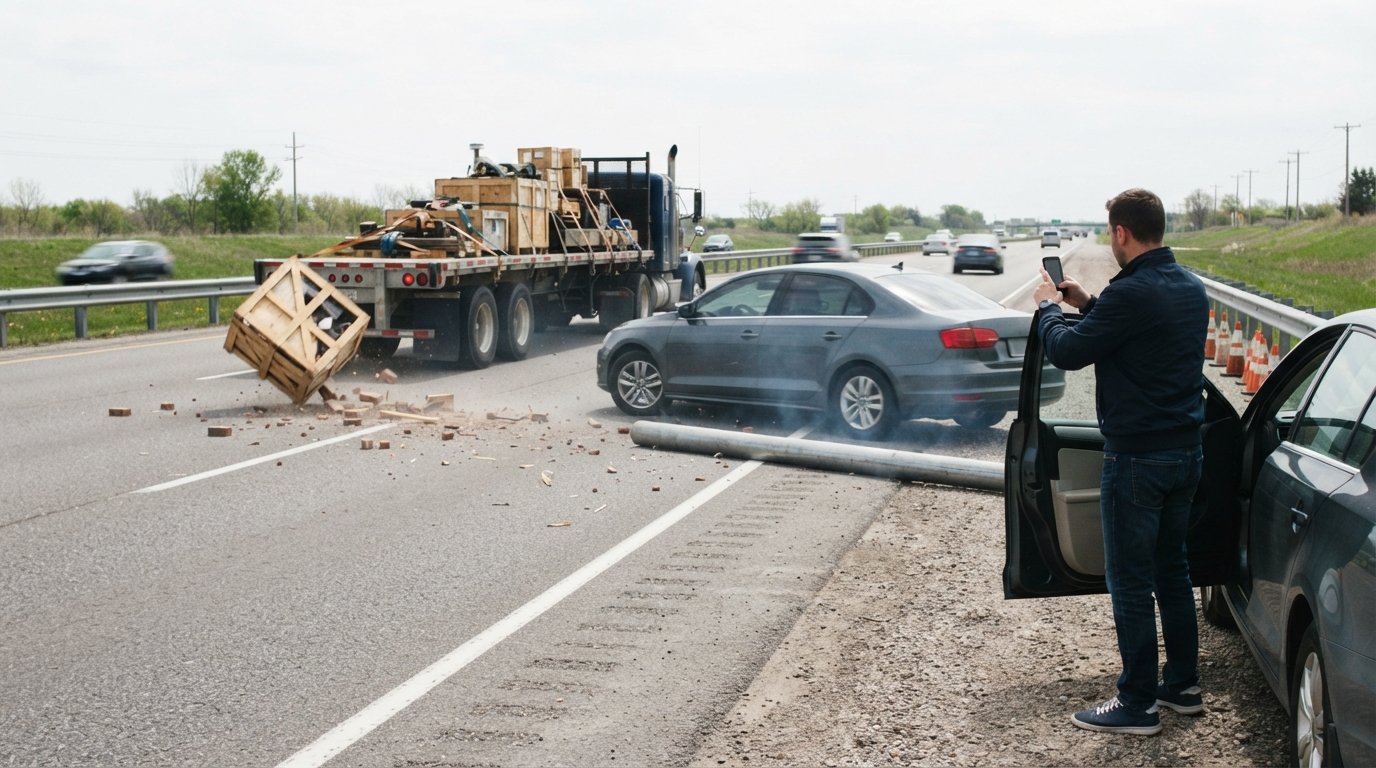
A crate tumbles off a flatbed ahead of you. A pipe rolls across three lanes. A pallet of bricks shatters on the asphalt and your car has nowhere to go. In the seconds after a cargo spill accident on the highway, the scene feels chaotic, and the claim process that follows can feel even more confusing. You are not just dealing with a dented fender. You are dealing with a commercial trucking operation, a shipper who loaded the goods, a carrier whose driver hit the road, and an insurance system built to protect them, not you. The steps you take in the first hours and days after the spill often decide whether your claim is paid or fought.
This guide walks through the cargo spill accident on the highway claim steps in plain language, from securing the scene to preserving evidence to notifying the right regulators. It explains the securement rules that trucking companies must follow, how to identify every party who touched the load, and why photographing debris matters more than most drivers realize. It also explains where a free case review fits in, because a spill claim is rarely a simple fender bender. If you were hurt by debris from an unsecured load, the goal is simple: build a record so clear that the insurer has little room to argue.
Why Cargo Spill Claims Are Different From Ordinary Crash Claims
A standard rear-end collision usually involves two drivers and two insurers. A cargo spill accident on the highway involves at least three potential defendants: the driver, the motor carrier that employed the driver, and the shipper or loader who prepared the cargo. Sometimes a maintenance contractor, a leasing company, or a broker also shares responsibility. Each of those parties has its own insurance policy, its own lawyers, and its own incentive to point the finger at someone else. That complexity is exactly why the claim steps matter so much.
Federal rules add another layer. Commercial motor carriers must comply with cargo securement standards found in the Federal Motor Carrier Safety Administration regulations, commonly cited as 49 CFR 393.100 through 393.136. Those rules set minimum performance criteria for tiedowns, working load limits, and the number of securement devices required for different types of cargo. When a load spills, the first legal question is often whether those rules were followed. A well-documented claim forces the carrier to answer that question with records, not excuses.
There is also a practical difference in how injuries happen. Debris strikes vehicles, triggers secondary collisions, or forces evasive swerves that end in rollovers. The chain of causation can stretch across several cars and several hundred feet of roadway. Proving that a specific piece of cargo from a specific truck caused your injury requires a paper trail that starts at the scene. Building that trail is the heart of the cargo spill accident on the highway claim steps.
Step One: Secure the Scene and Call for Help
Safety comes before evidence. If you can move your vehicle out of live traffic, do so carefully, and turn on your hazard lights. If the debris field is extensive or a load is still shifting, stay in your car with your seatbelt fastened and call 911. Do not walk into traffic to pick up cargo, and do not try to help unload a truck. Spilled cargo can include hazardous materials, sharp objects, or heavy items that shift without warning.
When law enforcement arrives, tell the officer exactly what you saw: which vehicle the debris came from, where it struck your car, and how the spill affected traffic. Ask that the crash report note the cargo spill and the commercial vehicle involved. The police report is one of the first documents an insurer will read, and a report that describes an unsecured load is worth more than a report that simply says debris was in the road.
Seek medical attention even if you feel fine. Adrenaline masks symptoms, and soft tissue injuries often appear hours later. A medical record created on the day of the crash links your injuries to the event, which matters when the carrier's insurer argues that your back pain started sometime else. If you are unsure whether you need a lawyer, a no-cost case review can help you understand your options without any obligation.
Step Two: Photograph the Debris and the Scene Conditions
Photographs are the most persuasive evidence in a cargo spill case, and they are also the most perishable. Road crews clear debris quickly, and the trucking company may move its rig before investigators arrive. Take pictures as soon as it is safe, and take more than you think you need.
Useful images include the debris itself with something for scale, the cargo labels or shipping marks, the truck and its trailer if still present, the position of your vehicle relative to the debris field, road conditions, weather, and any skid marks or gouges in the pavement. If the cargo has labels showing a shipper name or a bill of lading number, photograph those labels clearly. That single photo can identify the shipper and unlock the entire chain of responsibility.
Video is equally valuable. A short walkaround that captures the scene in context, including traffic patterns and signage, helps an investigator reconstruct what happened. If witnesses stop, ask for their names and phone numbers, and photograph their license plates if they are willing. Witness statements that confirm an unsecured load are difficult for a carrier to rebut later.
Step Three: Identify the Shipper, Loader, and Carrier
One of the most important cargo spill accident on the highway claim steps is figuring out who is legally responsible. The driver is the obvious starting point, but the driver's employer, the company that loaded the trailer, and the business that arranged the shipment may all share liability. Each entity has different insurance and different defenses.
Start with the police report, which should list the commercial vehicle's DOT number and the carrier's name. The DOT number is a key that unlocks public records. You can look up the carrier's safety history, insurance filings, and inspection results through federal databases. If the trailer displays a USDOT number or a company name, photograph it. If the driver hands you an insurance card, photograph both sides.
Shipping documents matter just as much. A bill of lading identifies the shipper, the consignee, and sometimes the loader. If you can obtain a copy through the carrier or through your attorney's investigation, it can show who was responsible for securing the load. In many spill cases, the loader failed to distribute weight properly, used inadequate tiedowns, or skipped a required inspection. Those failures are the building blocks of a negligence claim.
If you were also the victim of a driver who fled the scene, the steps overlap with other crash types. Our guide on what to do after a hit and run accident explains how to preserve evidence when the at-fault party disappears, and the same urgency applies when a truck spills cargo and keeps moving.
Step Four: Notify the State Agency That Regulates Carriers
Commercial carriers answer to more than the police. Each state has an agency that regulates intrastate motor carriers, and the federal government regulates interstate operations. Filing a complaint or report with the appropriate agency creates an official record and can trigger an investigation into the carrier's securement practices.
The exact agency varies by state, but common contacts include the state department of transportation, the state highway patrol's commercial vehicle division, and the public utility commission in some jurisdictions. If the carrier operates across state lines, the Federal Motor Carrier Safety Administration also accepts safety complaints. You do not need to know the full regulatory structure to take this step. A simple written report that describes the spill, identifies the carrier, and notes any visible securement failures is enough to get the process started.
Keep copies of everything you submit. Agency records can later support your claim by showing that the carrier had notice of a problem or that an investigation confirmed a violation. Insurance adjusters take these records seriously because they signal that the claim is organized and that someone is watching.
Step Five: Preserve Evidence and Send a Spoliation Notice
Trucking companies are required to keep certain records, including driver logs, maintenance files, and cargo securement documentation, but those records do not stay available forever. A spoliation letter is a formal written demand that the carrier preserve evidence such as the truck, the trailer, the tiedowns, the shipping documents, and the driver's electronic logs. Sending one early prevents the carrier from quietly discarding the very evidence that would prove your case.
Your own evidence needs protection too. Keep your damaged vehicle until an adjuster or your attorney has inspected it. Save your clothing, your phone, and any dash camera footage. If your vehicle has a telematics system or event data recorder, ask that the data be preserved. Download any photos and videos to a secure location and back them up. The more complete your file, the stronger your negotiating position when the insurer makes an offer.
Step Six: Document Your Losses and Build the Claim
Compensation in a cargo spill case goes beyond vehicle repair. Document every expense and every impact on your life, because the insurer will not volunteer to pay for what you do not claim. A well-organized damages file typically includes medical bills, lost wage records, repair estimates, rental car receipts, and a written account of how the injury affected your daily routine.
Keep a simple injury journal. Note your pain levels, medical appointments, missed work, and any activities you had to give up. This record is not glamorous, but it converts vague suffering into concrete evidence. If a doctor recommends ongoing treatment, follow through. Gaps in treatment are one of the most common arguments insurers use to reduce a settlement.
When you are ready to negotiate, remember that the carrier's insurer is not on your side. It may offer a quick settlement before you know the full extent of your injuries. Do not sign a release until you understand what you are giving up. A free, confidential case review through CheapInjuryLawyer can connect you with a participating personal injury attorney who works on contingency, so you can evaluate your claim without paying upfront. The service is not a law firm and does not provide legal advice, but it can help you decide whether professional representation makes sense for your situation.
Step Seven: Understand Deadlines and Fault Rules
Every state sets its own deadline for filing a personal injury lawsuit, and those deadlines vary widely. Some states give you two years, others allow three, and a few have shorter windows for certain claims. Missing the deadline can end your case regardless of how strong the evidence is. Because cargo spill cases often involve multiple defendants, the deadline analysis can be more complicated than it looks.
Fault rules also vary. Some states follow pure comparative fault, reducing your recovery by your percentage of responsibility. Others follow modified comparative fault with a threshold, and a few follow contributory negligence rules that can bar recovery entirely if you share any fault. The way a court applies these rules to a highway spill depends on the facts of your case, which is why an attorney who knows your state's law is valuable.
Insurance requirements differ too. Commercial carriers must carry minimum liability coverage, but the limits and the filing requirements depend on the type of operation and the state. Knowing the carrier's coverage helps you understand what is realistically available to compensate your injuries.
Common Mistakes That Weaken a Cargo Spill Claim
Even careful drivers make mistakes after a frightening crash. The most common errors include leaving the scene before police arrive, failing to photograph the debris, accepting a quick settlement before treatment is complete, and posting details about the crash on social media. Insurers routinely review public posts for statements that contradict a claim.
Another frequent mistake is assuming the truck driver is the only responsible party. The carrier, the shipper, and the loader may all bear responsibility, and focusing only on the driver can leave money on the table. A thorough investigation looks at every link in the chain, from the warehouse to the highway.
Finally, many injured drivers wait too long to seek legal guidance. Evidence disappears, memories fade, and deadlines creep closer. The earlier you start organizing your claim, the more options you preserve.
When to Bring in Professional Help
Not every cargo spill case requires a lawyer, but the signs that you need one are fairly clear. If you were injured, if the carrier disputes fault, if the debris caused a multi-vehicle crash, or if the insurer's offer seems low, professional help can change the outcome. Trucking companies have teams of investigators and lawyers who respond to crashes quickly. You deserve someone who understands how those teams operate.
A participating attorney can request the carrier's safety records, depose the driver, retain an accident reconstruction expert, and negotiate with multiple insurers at once. Those steps are difficult to complete alone while recovering from injuries. A free case review is a low-risk way to find out whether you have a claim worth pursuing. Remember that submitting a request does not create an attorney-client relationship and does not obligate you to hire anyone.
The cargo spill accident on the highway claim steps are not complicated in theory, but they demand discipline in practice. Secure the scene, photograph everything, identify every party, notify the regulators, preserve the evidence, document your losses, and watch the deadlines. Do those things, and you give yourself the best chance at a fair recovery after someone else's unsecured load turned your commute into a crash scene.