
Rear Ended Twice: Who Pays in a Chain Reaction Crash?
Rear ended twice in a chain reaction crash? Call (855)-545-2917 for a free case review and learn who pays when multiple drivers are involved.

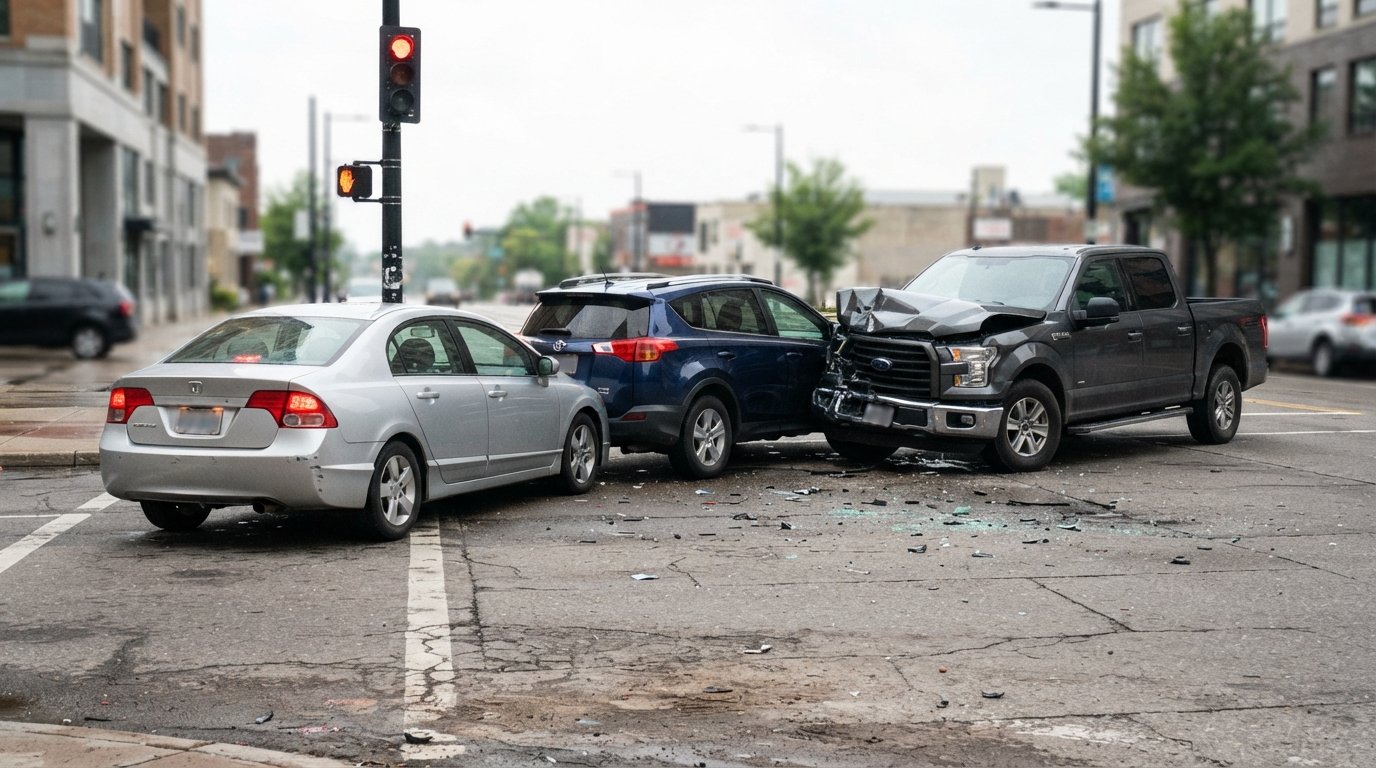
You are sitting at a red light when you feel a sudden jolt from behind. Before you can even process what happened, a second impact slams you forward into the car ahead. In a matter of seconds, you have been rear ended twice in a chain reaction crash. Now you are left wondering: who pays for the damage to your vehicle and your injuries? The answer is rarely straightforward, because multiple drivers, multiple insurance policies, and competing fault theories all come into play. This article breaks down how liability is determined in stacked rear-end collisions, when the middle driver is treated as a victim rather than a culprit, and what evidence you need to protect your claim.
How the Presumption of Fault Works Against a Rear Driver
In most U.S. states, the law starts with a simple presumption: the driver who rear ends another vehicle is presumed to be at fault. The reasoning is that a following driver should maintain enough distance to stop safely if traffic ahead slows or halts. This presumption is powerful because it shifts the initial burden onto the rear driver to prove they were not negligent. In a chain reaction crash, however, that presumption can become complicated when there are multiple rear impacts.
Consider a three-car pileup. Car A is stopped. Car B stops behind Car A. Car C fails to stop and rear ends Car B, pushing Car B into Car A. In this scenario, Car C is the initial rear-ender and is typically presumed at fault for both impacts. But what if Car B had already hit Car A before Car C arrived? Then Car B may bear responsibility for the first collision, while Car C bears responsibility for the second. The presumption of fault against a rear driver is not absolute, and it can be rebutted with evidence that the front driver stopped suddenly, had faulty brake lights, or was otherwise negligent.
The key takeaway is that the rear-end presumption is a starting point, not a final verdict. In a chain reaction crash, courts and insurers must untangle which driver caused which impact. That is why the sequence of collisions and the physical evidence at the scene matter so much.
When the Middle Driver Is Treated as a Victim Instead of at Fault
The middle driver in a three-car chain reaction is often in the most precarious legal position. They were hit from behind, but they also hit the car in front. Insurers for the front and rear vehicles may both point fingers at the middle driver. However, the middle driver can be treated as a victim rather than at fault if they can show they were pushed into the car ahead by the force of the rear impact.
This is where the concept of proximate cause becomes critical. If the middle driver was stopped or moving slowly and was violently propelled forward by a rear-ending vehicle, the rear driver is the proximate cause of both the middle driver's injuries and the front driver's damage. The middle driver's actions did not independently cause the forward collision; the rear driver's negligence did. In such cases, the middle driver is a victim of the rear driver's negligence and may recover damages from that driver's insurance policy.
To establish victim status, the middle driver should gather evidence that shows they had no opportunity to avoid the forward impact. This includes:
- Police report narratives that describe the sequence of impacts
- Photographs of vehicle damage showing the rear of the middle car crushed inward and the front of the middle car damaged from the secondary impact
- Witness statements confirming the middle car was stopped or moving slowly before being hit
- Medical records documenting injuries consistent with a rear-end push into a forward collision
If the evidence supports that the middle driver was simply a conduit for the rear driver's force, they are far more likely to be treated as a victim. But if the middle driver was tailgating the front car or already in motion when the rear impact occurred, the analysis changes.
Why Police Reports and Vehicle Damage Points Matter
In any chain reaction crash, the police report is often the single most important document for sorting out fault. Officers responding to the scene will interview drivers and witnesses, observe vehicle positions, and note damage patterns. Their report may include a diagram showing the order of vehicles and the points of impact. While police reports are not always admissible as evidence in court, insurance adjusters rely heavily on them when evaluating claims.
Vehicle damage points are equally telling. The location and severity of damage can reveal which impact happened first and how forces traveled through the vehicles. For example, if the middle car has severe rear-end damage and only moderate front-end damage, that suggests the rear impact was the primary force. If the front car has damage consistent with being hit by a vehicle that was already accelerating, that supports the theory that the middle car was pushed. An accident reconstruction expert can analyze crush patterns and vehicle trajectories to determine the sequence of events.
For a driver who was rear ended twice, documenting damage from multiple angles is essential. Take photos of all vehicles involved, including close-ups of the damage zones. Note the positions of the vehicles before they are moved. Exchange insurance information with every driver, and get contact information for witnesses. The more contemporaneous evidence you collect, the easier it will be to establish who caused which impact.
Coordinating Claims Across Multiple Insurance Policies
Chain reaction crashes often involve three or more vehicles, which means multiple insurance policies. Coordinating claims across those policies can be complex, but understanding the basic framework helps. Each driver's liability insurance policy typically covers damage they cause to others, up to policy limits. In a multi-car pileup, adjusters must determine which driver is liable for which portion of the damage and then allocate claims accordingly.
Suppose Driver C rear ends Driver B, pushing B into Driver A. Driver C's liability policy would likely cover Damage to B and A. Driver B's policy might also be involved if B contributed to the collision. If fault is disputed, each insurer may conduct its own investigation and reach different conclusions. This can lead to delays and disputes over who pays what.
If you were rear ended twice, you may have claims against more than one policy. For example, you might recover from the rear driver's policy for the initial impact and from another driver's policy for the secondary impact. In some states, you can also use your own collision coverage or uninsured/underinsured motorist coverage to speed up repairs while the liability dispute is resolved. A personal injury attorney can help you identify all available policies and pursue claims efficiently. If you are looking for a free, confidential case review, services like CheapInjuryLawyer connect injured people with participating attorneys who work on contingency, so you pay nothing upfront.
For a deeper look at how fault is determined when vehicles collide at an angle, see our guide on T-bone car accident fault at intersections.
Steps to Take After Being Rear Ended Twice
If you find yourself in a chain reaction crash, your actions in the minutes and days afterward can significantly affect your ability to recover. Here are the key steps to follow:
- Ensure safety first. Move to a safe location if possible, turn on hazard lights, and check for injuries. Call 911 if anyone is hurt.
- Call the police. A formal police report is crucial for documenting the sequence of impacts and identifying all involved drivers.
- Document the scene. Take photos of all vehicles, damage, road conditions, and traffic signals. Get names and contact information for all drivers and witnesses.
- Seek medical attention. Even if you feel fine, get checked out. Injuries from rear-end collisions often appear hours or days later.
- Notify your insurer. Report the accident to your own insurance company promptly, but avoid giving recorded statements to other drivers' insurers without legal guidance.
- Consult an attorney. A free case review can help you understand your rights and options in a multi-vehicle crash.
Following these steps preserves evidence and protects your claim. If you were rear ended twice, the sequence of impacts will be central to your case, so do not skip documentation.
Comparative Fault in Multi-Vehicle Crashes
Most states follow some form of comparative fault, meaning each driver's responsibility is weighed against the others. In a chain reaction crash, a driver might be 70 percent at fault for one impact and 30 percent at fault for another. Comparative fault rules vary by state, and some states follow pure comparative fault while others use modified comparative fault with a 50 or 51 percent bar. This means that if you are found partially at fault, your recovery may be reduced or barred entirely.
For the middle driver, comparative fault analysis is critical. If they are found even slightly at fault for the forward collision, their recovery from the front driver may be reduced. However, if they can prove they were pushed by the rear driver, they should bear no fault for the forward impact. An attorney can help present evidence that minimizes your fault and maximizes your recovery.
Because fault rules and insurance requirements vary by state, it is wise to consult with a lawyer familiar with your jurisdiction. A free, no-obligation case review can clarify how comparative fault might apply to your situation.
How a Free Case Review Can Help
If you were rear ended twice in a chain reaction crash, you may be facing medical bills, vehicle repairs, and lost wages while insurers argue over fault. A free case review from a participating attorney can help you understand your legal options without any upfront cost. AutoInjuryAccident.com is not a law firm or lawyer referral service and does not provide legal advice, but it connects injured people with attorneys who advertise on the site. Submitting a form does not create an attorney-client relationship or obligate you to hire a lawyer.
Many personal injury attorneys work on contingency, meaning you pay nothing unless they recover compensation for you. That makes a case review a low-risk way to get clarity on a complicated multi-vehicle crash. Whether you were the front driver, the middle driver, or the rear driver, understanding your rights is the first step toward a fair resolution.
Chain reaction crashes are rarely simple, but with the right evidence and legal guidance, you can protect your interests and pursue the compensation you deserve.